Peace Watch » Editor's Take » Story of Shimla Agreement
Story of Shimla Agreement
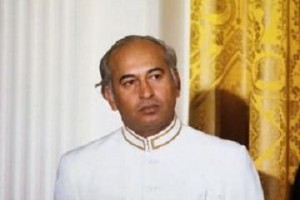 Truth About Shimla Agreement
Z.G. Muhammad
Forty three years back on 2 July at Shimla, a bilateral agreement was signed between India and Pakistan. Since their birth as independent dominions the two countries have signed number of agreements some under international umbrellas and some under auspices of friendly countries. But, out of all the agreements between the two countries, New Delhi has been attaching lot of importance to this agreement and has been looking at it, as a ‘great diplomatic achievement’. The agreement having its genesis in a war that in the words of Ramachandra Guha, was hailed as “India’s first military victory in Centuries” and a ‘breach in fortress of Islam’, is being looked as totem of victory over the arch rival. Notwithstanding, India and Pakistan relations even after 1972 more than often continuing be to be on a shot fuse the Simla Agreement remained central to India and Pakistan narrative. In May 1999, the two countries fought another limited war in mountains of Kargil. This was followed by nine months long standoff in 2002, with eight lakh soldiers of two countries facing each other eye ball to eye ball. The two countries moved ballistic missiles to the borders and the heightened tension portended a nuclear in the region. Despite, the Simla Agreement being in place, it was third party mediation- the US intervention that ended war in Kargil. So is true about the ending of 2002 standoff. Historically, after every phase of tension, it is third party mediation or nudging by the United States that defuses the situation. And when it comes to talks on Kashmir the Simla Agreement discourse again gains currency. Every Indian Prime Minister, since inking of this agreement has been talking about resolution of all outstanding issuing including Kashmir with Pakistan under this agreement. Despite, the war of attrition going on between Islamabad and New Delhi, after the BJP government called off scheduled Secretary level talks in August 2014, Prime Minister, Modi has been talking about holding talks with Pakistan under this very agreement. In April, this year in an interview with Hindu he said that we remain open to bilateral dialogue with Pakistan on all outstanding issues in an environment free from terrorism and violence. The Simla Agreement and Lahore Declaration, the two bilateral agreements 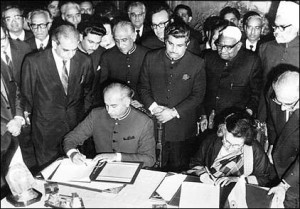 one signed by Prime Minister, Indira Gandhi and President, Zulfikar Ali Bhutto and another by Prime Minister Atal Bihari Vajpayee, have to be the basis for going forward.” It also is history, the two countries have always started their dialogue at the behest of a third party. Amidst lot of rhetoric since, with two countries planning to go to UN, it is after calls by the US and other global powers that Modi and Sharif are expected to meet on the side-lines of the Shanghai Cooperation Organisation (SCO) Summit in Russia this week. International community, after remarks by Prime Minister, Modi in Dhaka has been concerned about mounting tension between the two countries. Washington, has publicly stated that it wants to see tension between the two countries defused. ‘There are also indications that Russia and China would also like two PMs to have a dialogue.’ In all crisis between India and Pakistan, even after the Simla Agreement there has been a third party mediation is a hard reality. Notwithstanding, these realties, New Delhi, in its discourses particularly about Kashmir has been more emphatic about adhering to this agreement. It has been New Delhi’s belief that this bilateral agreement has superseded the United Nations resolutions calling for holding of a plebiscite in Jammu and Kashmir under its auspices for deciding the future of the state. Taking recluse under this agreement, it has been ruling out a third party mediation or internationalizing the Kashmir Dispute. It is a recognized fact, no bilateral agreement can override an international agreement. International agreements are binding for the nations, while as bilateral agreements between two countries that concern right to self-determination of people guaranteed by the United Nations Security are not binding for the comity of nations unless, a referendum is held over acceptability of this agreement by the people whose fate such an agreement affects. Having said that a closer scrutiny of the drafts exchanged between the two countries at Shimla from 28 June 1972 to final draft reached at midnight of July 2-3 reveals, that India team made all efforts to seek Pakistan’s ‘acquiescence’ on status quo in Jammu and Kashmir. ‘India presented an elaborate treaty that comprised eleven articles, it incorporated settlement of Kashmir. Pakistan presented its own draft agreement. ‘The most substantive differences between two agreements centred on Jammu and Kashmir. Pakistan made no mention to Kashmir, in its view the purpose of Simla Conference was limited to the problem born from December war. India insisted on making Kashmir part of deliberation. It did change phraseology in subsequent drafts but fundamentally aiming at converting the Ceasefire Line into permanent border. On July 2, Indian team suggested that the line of control resulting from 17 December 1971, henceforth to be respected by both sides as ‘line of peace’ in Jammu and Kashmir. “The formulation was designed to convert the temporary CFL/LOC into an international boundary.” To pave way for withdrawal of UN mandated UNMOGIP and undermine
  validity of UN resolution Indian team suggested creation of a ‘bilateral supervisory body’. Pakistan got this clause deleted. The UNMOGIP continue to be present on both the sides of the LOC. Seen in right perspective the only Kashmir related clause in the agreement is in Para 4 (ii) of Simla Pact which reads: “In Jammu and Kashmir the line of control resulting from the CFL of December 17, 1971 shall be respected by both the sides without prejudice to the recognized position of either side…” The words “In accordance with Charter of United Nation” in the agreement have greater implications, under it ‘a state has the right to bring to the notice of General Assembly or the Security Council any matter which threatens international peace. Article 103 of Charter Affirms, ‘that obligations under charter prevail over conflicting obligations under any other obligation.’ So, Shimla Agreement has not changed stated position of Kashmir Problem. (Published in Greater Kashmir 6-7-15


Filed under: Editor's Take