Peace Watch » Editor's Take » My Presentation on Novel Torchbearer By G.N. Gowhar – In M.D. Taseer Hall, Srinagar
My Presentation on Novel Torchbearer By G.N. Gowhar – In M.D. Taseer Hall, Srinagar
Review of “Torch Bearer” A Novel by G.N. Gowhar.
By
Zahid. G. Muhammad
Venu
M.D. Taseer Hall, A.S. College, Srinagar
Thank you Gowhar Sahib, for giving me an opportunity to read your novel and then review the same.
I do not know why? While coming to this place names of Palestine poet Mehmood Darwish, Tawifq Zayyad and Fadwa Tuqan persistently knocked my mind…it sounds ironic, why I did not remember any of the contemporary poets of my mother tongue…the language I love and relish.
Perhaps, I was caught up in a web of dilemmas- should I look at the Torchbearer merely as a piece of literature and discuss it simply as a genre of literature. Is this novel charged with defiance, does it cascade with pain and agony that people of this land have been undergoing, does it speak of persecution, should I look at as literature of protest or literature of resistance…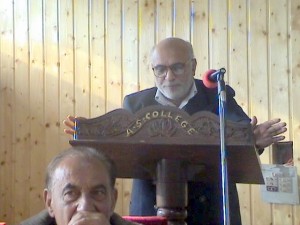
Somehow, the novel has left an impression on my mind that I think has been best articulated by Tawfiq Zayyad in his poem titled Impossible:
“ It is much easier for you
To push an elephant through a needle’s eye,
Catch fried fish in galaxy,
Blow out the sun,
Imprison the wind,
Or make a crocodile speak,
Than to destroy by persecution
The shimmering glow of a belief
Or check our march
Towards our cause
One single step………….”
The literary scene at our place, ‘despite shimmering glow of our belief”, has been disappointing. It is disappointing for our literati, writers and poets’ largely failing to sing songs of compassion for their compatriots- it is hurting when they give in to the expediencies.
Of late, I have started believing that the looming clouds of disappointment have started vanishing from our literary scene and we are on the threshold of a renaissance- a renaissance in our own right. One, after another book telling the peoples tale are added to Kashmir-English literature. ‘Torch Bearer: In Dark Circles by Ghulam Nabi Gauhar published by Raider Publishing International, New York, London and Cape Town is the third novel in a succession – the earlier two being the Collaborator by Waheed Mirza and The Half Widow by Shafi Ahmed.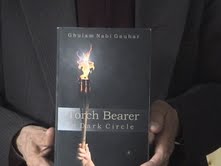
The 1183, pages novel that perhaps is the first-ever voluminous novel written in English in Kashmir is epoch making not for its volume but for its canvass, that encapsulates the social, cultural and religious ethos of the land and epic struggle of its people for freedom.
To write a novel of this magnitude needs ‘energy, a prodigal, exuberant energy of creation that works almost like a force of nature.’
The story is weaved around romance between Areg, daughter of widow maidservant and Ashud (Asad), a poor Mashali (torchbearer) at marriage party of a middle class family, where Areg is one among the troupe of the girls and women singing greeting songs to bridegroom and Ashud is heading torchbearers accompanying the marriage party.
The novelist has used this important literary genre as medium to tell the story of Kashmir in its all subtlety without imposing it on his readers. He takes his readers on an odyssey to social and cultural cosmos of our land enables us to relish with all its intricate nuances, beauties, myths, totems and taboos.
He provides deeper insight into the psyche of his characters. At the marriage scene with all fineness, he tells us how loss of Kashmir’s sovereignty is deeply embedded in Kashmir psyche that even at most hilarious moments in the life of a Kashmiri pinpricks him and grimly remind him of the tragedies enacted for hundreds of years.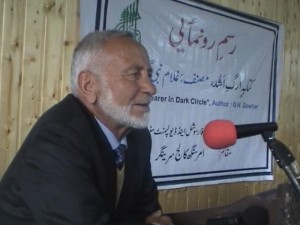
The enchanting beauty of Areg daughter of maidservant holds bridegroom on the horseback spellbound – reminds him of the fabulous love story of Yousuf Shah Chak and the peasant girl. For beauty of Areg, he believes she also deserves to be a queen but suddenly remembers:
“We Kashmiris by now have no royal families, we have since that last monarch ceased to be rulers we are now only subjects to be ruled.”
Locale of the story is old Srinagar city; the crucible of Kashmir’s culture and social ethos, cradle of its literary traditions, the abode of greatest mystics and saints, , capital of greatest Sultans of Kashmir and epicenter of all the resistance movements. The drama of love story unfolds in this part of the city, around the same time when struggle against the autocratic, bigoted and discriminatory rule was its striking roots in the shape of the reading room. The novel for minutest details, peeping into the minds of the leaders, providing an insight into their thinking is more than a book on history of Kashmir freedom struggle.
The novel on more than one count is comparable to ‘Shalimar the Clown’. In this internationally bestseller novel on the love story between Boony Koul a Kashmiri Pandit girl and Noman Band, son of ministerial couple unfolds during the Kashmir struggle. The novelist in this work of art also deftly weaves real characters from Kashmir struggle in his plot. The story goes far beyond the confines of Kashmir travels along with the protagonist from continent to continent. In the Torch Bearer Gauhar also artistically allows full role to real characters of Kashmir Freedom struggle along with his fictitious characters thus tells the story of Kashmir with its melodramas and tragedies. Allowing his characters role outside Kashmir valley, he extends his story to undivided Punjab, not only the second home to Kashmiris but also bastion of Kashmir struggle for freedom.
On July 1931, when soldiers of the autocratic ruler shot down unarmed Muslims outside the Srinagar Central jail like coots in Hakursar or Anchar Lake, killing 26 of them and wounding many others the tragedy of this tiny nation also becomes personal tragedy of Areg. Her fiancé Ashud disappears on the same day never to be found. To get the story going and bring elements of surprise in it Gowhar, makes Areg and Ashud to consummate….
This personal tragedy brings this girl of humble origin to the Central stage, to play a role in the freedom struggle along with real characters like Sheikh Muhammad Abdullah and Ghulam Ahmed Ashai and fancied characters like Zeerak Shah.
Every character in the novel is true to life. The author through his characters brings out the economic scenario as it obtained in Srinagar during thirties. Giving a kaleidoscopic view of trade and commerce in Kashmir, he exposes machinations of the feudal rulers by establishing traders Khataris from Punjab and giving monopoly of Kashmir traders to fifteen Hindu families from Punjab: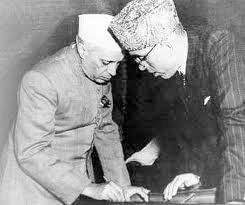
“The cream from profit goes by way of commission to those wholesale suppliers – the Lalas in Maharaja Gunj, originally from Punjab. Local traders earn meager as to be equated to what they could earn as wages of the labour put in.”
On many an occasion the novelist in his magnum opus involves us into very complex intellectual discussions that might have been part of Kashmir’s political narrative during past eighty one years. At times, we see researcher in the novelist interplaying in the story. Narrating the story of 1931 happenings, he reminds us how Mongol desperado in 1380 had killed scores of Reshies while they were in deep meditation.
At places, it disturbingly provocative, if I was reading a novel or an authentic political commentary on the faux pas of protagonists of the Kashmir Freedom Struggle. Through his characters the author brings out stark realities about changing the Muslim Conference into the National Conference, the 1947 happenings, story of accession and baton and hoodlum rule after 1947, that most of contemporary historians out of expediencies have avoided to record with honesty. The novel is a commentary on the constitutional history of Jammu and Kashmir. The author with audacity tells tales about the personal weakness of the protagonist of Kashmir freedom struggle that worked as catalyst in adding to Kashmir tragedy. At places, the author resembles D.H. Lawrence in depicting elements of sensuality in his characters- fictional and real.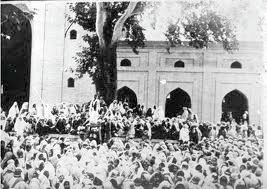
The craftsmanship of Gowhar Sahib as a novelist is distinctly visible through the portrayal of his characters. Like Charles Dickens he uses his characters to tell the sordid tale of miseries, sufferings and exploitation of people. Through the character of Daulat mother of Areg , the novelist provides us a deeper insight into social, cultural ethos of late twenties and early thirties. Through her only he introduces, the arrival of Islam in Kashmir and the love and reverence Kashmiris have for the saints who played pioneering role in the spread of Islam in in Kashmir. Through Ashud, he tells us the woeful tales of suffering of multitudes and enables to relive the days of poverty and subjugation of the overwhelming majority. Through, his character Zareek Shah, an embodiment wisdom and political astuteness he very subtly tells why Kashmir Freedom Struggle failed to achieve the desired goal and why it met one after another waterloos.
The novelist towards the end brings about reunion of Ashud and Areg – in 1990- but it is not a joyous moment but at a carnage- where five women of a family are raped and killed at a festive function by men in heavy boots…the scene sends shedders down the spine…
The novel despite brings as voluminous as Tolstoy’s War and Peace, hold the grip of the reader to the last.
I see the novel as harbinger of a new wave of literature that could be called as resistance literature of Kashmir.
Let me end this humble presentation with a quote from great Palestine women poet Fadwa Tuqan.
My beloved home land
No matter how long the millstone
Of pain and agony churns you
In the wilderness of tyranny,
They will never be able
To pluck your eyes
Or kill your hopes and dreams
Or crucify your will to rise
Or steel the smiles of our children
Or destroy and burn,
Because out from our deep sorrows,
Out from the freshness of our spilled blood
Out from the quiverings of life and death
Life will be reborn in you again………”
Thanking you
Zahid G Muhammad
17-10-2010


Filed under: Editor's Take
A piece of sensible literature perceived and delivered efficiently. You are inexhaustibly associated with the pains of your people not only in your homeland but elsewhere too. you transform pain into literature with pathos. The way you have linked your write up to some other pieces of literature round the globe, makes it a comparative study, a presentation and a review all in one. Thanks for sharing, you prove yourself "frequently brilliant".
I agree on every word Nighat Maam has said…be a guiding light