Peace Watch » Editor's Take » Kashmir: Converting Sacrifices into Success
Kashmir: Converting Sacrifices into Success
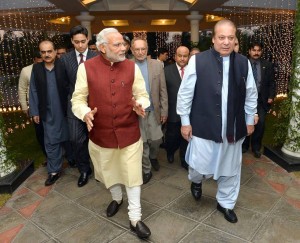
The Prime Minister, Shri Narendra Modi visits the Prime Minister of Pakistan, Mr. Nawaz Sharif’s home in Raiwind, where his grand-daughter’s wedding is being held, at Lahore, Pakistan on December 25, 2015.
PUNCHLINE
Converting Struggle into Resolution
By
Z. G. Muhammad
To invite attention, it costs us lives of our youth, hundreds with bullet wounds disabled for life and now scores of children pelleted to blindness. Such huge is the cost we pay to make the world acknowledge the right to self-determination of 16 million people of the State. Interestingly and intriguingly, it equally costs pools of blood to cause a debate in the Indian Parliament over the Kashmir situation and wake up the ruling elite in Islamabad to the hard realities of the Kashmir situation- not one portrayed by neo-progressive journalists of the country immune to the suffering of people.
That has been our story for past sixty-seven years. Nevertheless, after offering immense sacrifices and bringing back the dispute on the international diplomatic turf every time there is something amiss somewhere. That fails our sacrifices to see the international commitments guaranteeing the right to self-determination to people of the state translated into reality. Is it the failure of people across the dividing line to institutionalize their struggle at the international level that could have enabled them garner support for the cause? The fact of the matter is that we could not establish even an Institution like the Institute for Palestine Studies (IPS), one of the most reliable institution on Palestine in Washington. Established in Beirut in 1963, it has currently maintained an office in Beirut, Paris, Washington, and Ramallah. The question, why our sacrifices after making to the international diplomatic turf fail to produce tangible results should engage the attention of the Kashmir leadership, the Diaspora and intelligentsia. How our failure to be ambassadors of our cause has helped New Delhi to procrastinate and perpetuate the Dispute needs to be analysed dispassionately.
Let me not go into the history of debates in the Constituent Assembly of India or Indian Parliament testifying that New Delhi’s commitment to holding a plebiscite in the State to people of India and international community. But in this column, my focus will be New Delhi’s half-hearted approach to addressing the problem after mass uprisings in the State. In 2006, Prime Minister, Manmohan Singh constituted five Working Groups for addressing the Kashmir Problem. I am not to vouchsafe that the recommendation of the Working Groups would have any takers in Kashmir, moreover, if implemented these would have resolved the Kashmir Dispute. Nevertheless, some of the recommendation like repealing of the draconian laws would have created an atmosphere for initiating a dialogue between all the three contesting parties for creating a conducive atmosphere for settling the Kashmir Dispute amicably according to the basic principle of upholding the right of people to decide their future. The recommendation, after making them public were sent to the trashcan, only to be talked about after the 2008 mass uprising- later left on the shelves to gather the dust. These were brought into the public domain once again after the 2010 Intifada when Kashmir Dispute was once again in the headlines and debated in 2000 opinion pieces in the international media. Now when Kashmir is again in the headlines for blinding of children with pellets and killing of teenagers it has again become “cause of concern” for New Delhi. Ironically instead of looking at it as a political problem anchored in the birth of India and Pakistan it has been looking at it as a “law and order” problem. This mindset needs to be changed. Instead of a cosmetic approach like appointing interlocutors with no clear mandate, New Delhi needs to look at the Kashmir Dispute as candidly as was seen by some brilliant Indian minds like Pankaj Mishra and Swaminathan S. Anklesaria Aiyar in their writings during 2010 and come out of the denial mode. That, in fact, would be looking forward.
It is a hard historical reality that New Delhi’s Kashmir Policy continues to be Babu tailored as that in 1947 bordering on procrastination. It was this policy that brought Kashmir to the Security Council. For inventing narratives and conjuring alternative discourses on Kashmir, this policy once again going to bring Kashmir back to the UN as a nuclear flashpoint- disadvantageous to India looking for a big seat in the August body. It is in India’s own benefit to resolve the Kashmir Dispute in accordance with the UN resolutions.
On Friday 22 July 2016, after a gap of 23 years, Pakistan decided to knock the doors of the UNHRC for sending a fact-finding mission to the curfewed state of Jammu and Kashmir. This time, Islamabad has decided to approach the organization on its behalf and behalf of the Organisation of Islamic Cooperation (OIC) Contact Group on Kashmir. Pakistan had taken a similar initiative in 1993 when an international conference was arranged by ‘the popular Arab and Islamic Congress (PAIC) in Khartoum, and it had devoted several sessions to the plight of people of Kashmir and liberation struggles in Kashmir.’ The Muslim countries including Iran had with one voice assured Pakistan of support on Kashmir once it introduces a resolution in the 50th session of the UNHRC. Those days Washington was favourably disposed towards Kashmir and its Kashmir policy was as good as during the times of Eisenhower and Trueman. To see Islamabad not pressing its resolution, New Delhi made all-out diplomatic efforts and succeeded in winning over Iran President Akbar Hashemi Rafsanjani to use his influence and prevail upon Benazir Bhutto. The then Pakistan Prime Minister Benazir believing that Iranian President would mediate a solution of the Dispute withdrew the resolution to her disappointment New Delhi saying it never asked Rafsanjani to mediate. It was a great diplomatic victory for New Delhi and a big fiasco for Islamabad.
Had the Kashmir leadership on both sides at the time been robust enough to prevail upon the then Pakistan leadership, the contours of Kashmir struggle would have internationally changed to the advantage of people of the state. It would have taken out the Kashmir Dispute out of the diplomatic cobwebs of “bilateralism and “internal matter” that New Delhi has woven around it during past few decades and restored its international status – that of allowing people of Jammu and Kashmir exercising their right to self-determination.
There is a need for institutionalizing of the struggle at the international level for seeing the sacrifices of people translating into the resolution of the 67-year-old Dispute.
Published in Greater Kashmir on 25 July 2016.


Filed under: Editor's Take