Peace Watch » Editor's Take » Hurriyat Meeting Sinha- Sessions of Catharsis
Hurriyat Meeting Sinha- Sessions of Catharsis
Punchline
Sessions of Catharsis
By
-
Z. G. Muhammad
‘In peace time Kashmir is forgotten. And only remembered when the state is on a boil.’ Whenever people come on the streets, these clichés come handy to political commentators for analyzing the situation and reminding people of the power that all was not hunky dory in Jammu and Kashmir. These commentators are not wide of the mark in stating that during seemingly bouts of peace or after the State Assembly elections New Delhi purposely disregards the clear historical fault lines in the state politics. Instead, of recognizing the tectonic shifts under the crust even media by playing up things like tourist traffic in the state hallucinate the viewers across the India to make them believe that all was well in the State. That also holds true about the civil society activists and the think tanks in the capital they also have been seeing bustling marketplaces and traffic jams as indicators of “normalcy in the state forgetting the heat underneath. That loudly suggests that this peace is as susceptible to melting down on mere warmth as icicles during winters on a sunrise.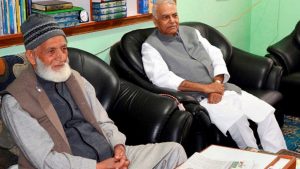
Since 1947, history is replete with instances when New Delhi showed interest the resolution of the Kashmir Dispute to be forgotten when it was off the international headlines. After people surged the roads in hundreds of thousands in the 1990s, Kashmir once again resonated on the floor of the United Nations made headlines and caught the attention of international human rights organizations. These developments made the governments in New Delhi to reach out to people directly or through intermediaries. Tens of delegations comprising renowned academician, intellectuals, and human rights activists visited jails and made it to Srinagar. They had met with Hurriyat leadership persuading them for entering into negotiations with New Delhi. One of the prime concern of all the visiting delegations, peaceniks, and civil society go-betweens was silencing of the guns and ending of militancy. For this purpose, the services of some former vice chancellors and senior journalists were also utilized. Even Prime Minister of India, Narshima Rao reached out to people of the state from a distant place like Burkina Faso a landlocked country in West Africa with ‘sky is the limit’ offers. In the nineties, it was also on grapevine that some leaders inside the jails were offered Bhutan like status. Nonetheless, after the 1996 elections that brought the National Conference into power, the pledges made to some resistance leaders behind the scene and in full media cause were forgotten. Not only the government in New Delhi even the civil society activists that frequented to Srinagar like shuttlecocks saw these elections as a major transition towards permanent peace in the State.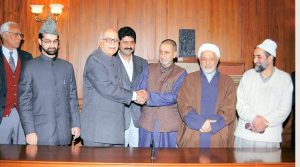
For the BJP leadership looking at the Kashmir Dispute as the Nehruvian legacy after the end of Congress Government in 1998 hopes had brightened in a section of Kashmir leadership that the right wing politicians will be interested in ending stalemate on Kashmir. This group decided to enter into purposeful dialogue with New Delhi. In this column, it may not be possible to go into details of this dialogue, if it was in line with the historicity of the dispute and wishes of people and what led to its fiasco. But, it is to suggest that this section of leaders for ending the stalemate on Kashmir took a risk and entered into an unproductive dialogue with New Delhi- only to be let down.
The stories of 2008 and 2010 ‘intifadas’ was seen internationally as a paradigm shift from armed struggle to the non-violent movement were not different. These protests followed by Mayhems like 1990s had brought Kashmir Dispute back into international spotlight. These intifadas had also caused thousands of honest, objective and sympathetic columns thus once again stirred a sort of shuttle diplomacy between Srinagar and New Delhi. Srinagar once again became mecca for civil society activists, think tank managers and members of parliament for addressing the Kashmir problem and restoring peace in the state. Intifada 2010 had also caused some initiatives by the Congress government only to be dumped after a semblance of peace returned to the state.
This policy of conning leaders by holding false promises in fact has caused trust deficit between Kashmir leadership and visiting teams from New Delhi. Many political commentators saw this trust deficit cause for Syed Ali Geelani, Mirwaiz Umar Farooq and Mohammad Yasin Malik not meeting group of the non-BJP parliamentary delegation during the visit of all-party delegation visit to Srinagar in early September.
Taking a departure from its September stand in a surprise move on past Monday when a five-member delegation from New Delhi led by former Foreign Minister and senior BJP leader Yashwant Sinha arrived in Srinagar the Hurriyat leaders Syed Ali Shah Geelani and Mirwaiz Farooq chose to meet them. ‘Has the trust deficit that had prevented them earlier been made up’ was the question posted by some journalist friends in social media. Or it was good spade work done by the managers of the Centre for Dialogue and Reconciliation that had coordinated and facilitated the meetings between the Hurriyat and other civil society formations that made Sinha’s visit “successful”. Notwithstanding, the party in power in New Delhi distancing itself from the visit most of the newspaper described it as “Track II initiative. Joseph Montville who coined this phrase in 1991 has broadly defined it as an “unofficial, informal interaction between members aimed at developing strategies to develop the public opinion that might help resolve the conflict.”
If one dispassionately analysis the meeting between the Hurriyat leadership, civil society activists and Yashwant Sinha’s team, these by and large have been sessions of catharsis. Every leader and group during the meeting purged their emotion by narrating the horrifying stories of 110 days trauma and macabre of killing, blinding, wounding and maiming children and youth of Kashmir. For ending these tragedies, the leaders and civil society actors saw the resolution of Kashmir Dispute as only answer. Despite Sinha and his delegation having no official mandate and recognition, the leaders and civil society groups met the delegation hope of conveying their concerns to powers that be in New Delhi.
In almost every meeting Sinha repeated, “We came here to understand the situation and share the pain of the people. We will sit down (after going back to Delhi) and see how we can proceed further.” He sounded positive when he said to a civil society group that ‘we heard your point of view, we also have our point of view. Next time, when we visit Srinagar, we will also keep our point before you. You may not agree with our eight points, and we may not agree with your two points but that could be a way forward, let us hope there is light across the tunnel.’
The crucial question as rightly posed by Noorani in his Saturday column is “whether the Modi dispensation at all intends to do anything substantially different from its present position.”
Published in GK 31-10-16


Filed under: Editor's Take