Peace Watch » Editor's Take » Hurriyat Conference Battle Of Ideas
Hurriyat Conference Battle Of Ideas
Hurriyat 3 What does this third chapter signify?
 Z.G. MUHAMMAD
“‘Birth with a bang and death with a whimper’, since fifties has been most prominent attribute of our political organizations fighting for right to self-determination. Is it going to be the fate of the Hurriyat Conference also, this question bothered me a few days back, when this multi-party combine suffered yet another fragmentation and the third Hurriyat Conference was born.
The first major crack in this multi-party combine took place in 2002. It caused a vertical division in this organization that despite inherent contradictions had remained together for about eleven years and fought some toughest political battles. The causes for this break up have been analyzed in this column in the past and these continue to be part of public memory to this date. So need not to be talked about once again. 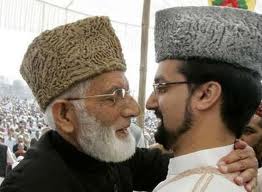
Ironically, despite fragmentation all the three factions call themselves as All Parties Hurriyat Conference- the name and style it had adopted in 1993, when twenty-six political, religious, and social organizations had joined to work as front-desk of the renewed struggle for right to self-determination, which at that time was overwhelmingly armed.
This multi-party forum was born, at time when over thirty five thousand militants and over hundred outfits were carrying out strikes across the state. In this bizarre scenario, this combine was the first non-combatant political face. Some important commentators and think tanks in New Delhi had seen its birth as positive development. Moreover, they believed through the forum they could reach to the combatants, ending violence, and finding a political solution of the problem.
The newspapers have styled the third faction as APHC(R) i.e. real, where as the other two have names of chairpersons suffixed to them. To understand the phenomenon of fragmentation in the conglomerate, it would be ideal to look at it through a historical perspective.
In 1948, and 1949, when the United Nations Security Council passed one after another resolution guaranteeing right to self-determination and providing mechanism for holding plebiscite for deciding future of Jammu and Kashmir, in more than one sense there was a political void in the State. Leadership and workers of organizations other than the ruling National Conference were either exiled or sent to jails. (Over ten thousands political leaders and workers were jailed). The party in power was very averse to the idea of holding plebiscite in the state and strived to subvert the UN resolution by agreeing to form the Constituent Assembly. 
It was only in mid fifties and early sixties that pro-right to self-determination parties appeared on the scene. Most of these organizations enjoyed popular support and had emerged as the people’s organizations. All other parties tethered to electoral politics were almost relegated to backyard of politics. Riding on the crests of popularity for decades, recognized internationally as voice of the people these organizations died with a whimper not for losing their popular base but for fatigue and desperation in their top leadership. It was out of weariness and not realpolitik that these leaders tried to reinterpret the movement they had led for decades and coined phrases like “ quality of accession is not dispute but quantum of accession” and retraced their steps. These leaders tried to find justification for the political fatigue and winding up 22-year long movement for plebiscite in the 1972 India and Pakistan Accord for return of POWs in Simla.
Nevertheless, knowing Simla agreement in no away affected the International Agreements on Kashmir signed under auspices of the United Nations; the fatigued Plebiscite Front leaders did not talk of redundancy of the UN resolution. Even the six-point Indira-Sheikh agreement denounced “as a document of abject surrender” does not describe UN resolution as “irrelevant.” The document in fact reiterates Sheikh Abdullah political beliefs before his deposition in 1953. Moreover, it talks about the relations between Srinagar and New Delhi shall continue to be governed by Article 370 of Indian constitution. As discussed in this column some weeks back this Article as emanates from the debates in the Constituent Assembly was introduced in view of the UN resolutions only as an interim measure before holding of plebiscite in Jammu and Kashmir- and largely testifies that Kashmir’s future is yet to decide.
Kashmir leadership in the past complained against the ineffectiveness of the UN in implementing its resolution but it has always been considering these resolutions as bedrock for the right to self-determination for the people of Kashmir. Only GOI has so far taken a stand that after state had gone nine times for poles these resolutions had outlived their utility. Often Kashmir leaders including Hurriyat have been contesting this claim of GOI on the strength of 1951 and 1957 resolutions of the UNSC that have categorically denounced these election in as much as ratifying accession is concerned. Historically it is for the first time that voices about ‘redundancy’ of the UN resolution are being raised in Kashmir that too from the platform of the APHC (M)- an organization that was wedded to these resolution through its own Constitution, that commits itself for achieving right to self-determination.
Ostensibly, for three important leaders of the Hurriyat Conference, viz Muhammad Azam Inqalabi, Shabir Ahmed Shah and Nayeem Ahmed Khan there have been two major reasons for alienation from the APHC (M) for past many years that ultimately culminated into birth of the third Hurriyat Conference. One, contemptuous remarks of Prof. Abdul Ghani Bhat, against UN resolution that comprises soul of the Constitution APHC and no action against him by the Chairman of the Combine or Executive Council of the organization for this indiscipline instead giving him a free hand for subverting the Constitution of the Conglomerate. . Second, reorganization of the multi-party combines and making it cadre based instead of making it a fiefdom and sanctuary for children of the leaders. It is debatable, if the APHC that is forum could have an organizational structure like other parties that lead the political movements. The conglomerate in fact belies very idea of the organization that have led movements across the globe, whether it has been India, Vietnam, Cuba or Pakistan. The party was born in 1993, with objective of providing collective leadership, it a separate debate if this concept is still relevant and if the conglomerate has same relevance as it had in 1993 at the time of its birth.
However, there is some truth in resentment shown by Azam Inqalbi, Shabir Shah and Nayeem Khan. But the question arises if the Hurriyat 3 will be to able to provide cohesive leadership and defeat machinations to change the Kashmir narrative by talking about redundancy of the UN resolutions,


Filed under: Editor's Take