Peace Watch » Editor's Take » Creative Resistance Humbles Mighty Powers- Fallen Chinar Turns Narrator
Creative Resistance Humbles Mighty Powers- Fallen Chinar Turns Narrator
Punchline
Art, Literature and Resistance
By
Z.G. Muhammad
 When a brush, a goblet of paint and a sheet of canvas sends shockwaves to the citadels of power. When a strip of celluloid causes the mighty to jitter in their high rise buildings. When a tune played on a Santoor shatters window panes of the bastions of the authority. When verses like “You may write me down in history—but still, like dust, I’ll rise” or “Write down! I am an Arab, And my identity card number is…..” erupts skins and causes rashes on the bodies of the usurpers of the rights of the people. Believe me; it is the victory of a nation struggling for its freedom or its rights.
Some days back New Delhi banned screening of “In the Shades of Fallen Chinar” a documentary on Kashmir at the 10th edition of the International Documentary and Short Film Festival of Kerala. It is a beautifully made film by two young filmmakers Fazil NC and Shawn Sebastian from Kerala that looks at the Kashmir tragedy through the eyes of young artists in Kashmir University, who had brought to life a fallen Chinar tree in the Naseem Bagh campus through their brush and paint. Fifteen students from Music and Fine Arts department like all children born and brought up during the past two and half decades of curfews, gruesome killings, custodial deaths, enforced disappearance and mass rapes bursting with angst used a fifty feet long trunk of the fallen Chinar tree as a medium to express their pent-up urge for freedom. Through their labor of love, they made it sing the saddest songs of their land. The muse in the log could catch the imagination of even commonest of commoners and not say about creative filmmakers- it had captured the imagination of two creative filmmakers from South India, who immortalized this piece of ‘resistance-art’ by capturing it on celluloid. 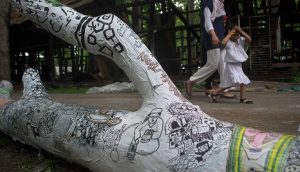
Lots of boys since the 2010-Intifada have adopted and popularized folk and various forms of the Western music as alternative forms of resistance. In picturizing some young music student, who have beautifully blended folk song and rap to tell the world the story of agony and pain of their people the filmmakers have added power and beauty to the documentary. In banning the documentary from screening at the International Film Festival, New Delhi has given more wings to Kashmir narrative to reach out to the global audience. True, the informed group of viewers at the film festival could not watch it, but overnight it became viral on social media across the globe. And ‘the Shades of Fallen Chinar’ became a new motif for the resistance movement of the land of Chinars.
In sensitizing the conscious international community and needling the conscience of people who matter, art, music, and literature have a significant role to play. The artists, rappers, singers, writers, and filmmakers are to be futures ambassadors and leaders of the land. I realized this when I saw some videos of a young Kashmiri rapper, at his best with “rhyme, rhythmic speech, and street vernacular” playing his guitar and singing songs of resistance to a big audience in historic Hyde Park, London known for over two centuries for free speeches and demonstrations. Music having universal language his songs at many other places did not attract only Kashmir Diaspora but large crowds of the Westerner- perhaps the audience that the pen pushers would not be able to reach out. In England only, there is more than a million of Kashmir Diaspora having a lot of potential for organizing such events for enabling the Kashmir rappers, singers, poets, and musicians to reach out to the world with their protest songs.
The 2016-Intifada internationally known as the year of “dead eyes” for blinding of hundreds of school going children with troops firing deadly pellets into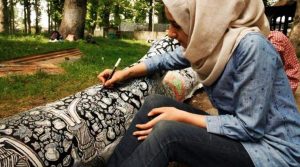
 their eyes made writers across the world to respond and write heart-wrenching write ups in the international press. Nevertheless, it has been some artists like Masood Hussain who through their art universalized the agony of blinding of children of Kashmir. Hussain’s visually arresting digital images of children pelleted to live with dead eyes for rest of their life on the social media stirred the conscience of even stone-hearted. Once, the artist translates these digital images on canvas in the history of Kashmir struggle these paintings will be as iconic as works of Norman Rockwell on the Civil Rights Movement in the United States.
The art, music, poetry, films, and literature are powerful weapons to deconstruct the ‘State narratives’ and demolish the ‘hegemonic discourses’ than many other forms of protests. In 2013, the State in collaboration with the German Embassy, New Delhi organized the Zubin Mehta’s concert in the Shalimar Garden for a high-profile select audience under cover of large contingents of the military. With about a million and a half citizens locked in their homes and heavy boots clicking theirs heals on streets, it was telecast all over the world not only by Indian television channels but by a premier television station in the world. The cultural event by no stretch of the imagination was a routine one; the objective behind was more than obvious. It was to tell the world that everything in Kashmir was hunky-dory- when the wounds of 2008, 2009 and 2010, bloody summers were still fresh.
Instead, of disturbing the official event and challenging the enormous military bandobast around the venue, people decided to hold a parallel concert “Haqeeqat-e-Kashmir” ( the reality of Kashmir) at a public park about ten kilometers away from the site of Zubin Mehta concert. Notwithstanding, harassment and impediments by the government the youth and civil society succeeded in putting a parallel show and through the language of art, rap, music, folk theater and poetry told the world that all was not well in the blood-drenched state. Moreover, attracting as good international attention as that of the official event- for which millions of rupees were spent.
Notwithstanding, the success of the “Haqeeqat-e-Kashmir and having the potential it could not grow into the full-fledged creative resistance movement. The reason has not been a lack of lack of talent, but much needed a big initiative for providing space to this form of resistance for growing.
Published in Greater Kashmir on 19-06-2017
Click :


Filed under: Editor's Take
There is no denial of the fact that all forms of art that depict the ❤ beat of suffering and dying people for the cause of liberty have their significant role to play in high lighting the tragedy and its long term dreadful fall outs .
The paintings and mainly poetry, converted into popular patriotic songs changed the dynamics of struggling nations for freedom. We saw in Kosovo how a simple, naive popular musical song, saying “oh Kosovo no matter I am far from you but do you know my heart cries and eyes are wet for you…..oh my beloved Kosovo”.
We had a patriotic song of Mahjoor that Abdullah Sheikh exploited as a political tool to earn public popularity to hide his real faces and hidden agendas.
I remember an internationally famous street artist went to Gaza and painted on wall over there the aftermath of Israeli bombing on starved and besieged Gazans which came on all media channels in west. A news reporter asked few people of Gaza their opinions. Almost all thanked artist and said ” it doesn’t change anything for us”.
We live in the world which is more and more governed, over the time, by Zionist concept of morality as subservient of state morality and value of international public opinion v/s state interests . And this is not only disaster for people fighting for their freedom but equally for international law. what is highly unfortunate and regrettable that countries like India, a secular democracy, is borrowing these political concepts to be introduced in its changing political idea of India as Hindu Rashtra.
Gandhi used to say men of truth must have men of believe, who can believe and listen the truth.
The world we are living in desperately needs rather cries for people of goodwill with humanistic understanding.
Let us keep fingers crossed and stay optimistic that good sense will prevail over jingoistic framers of state policy, to give all kinds of non violent means and expressions for freedom a close look and serious thought for the good of all.