Peace Watch » Editor's Take » Article 370 and UN Resolutions are “dove-tailed”
Article 370 and UN Resolutions are “dove-tailed”
Punchline
370 and United Nations
By
Z. G. Muhammad
Thank you Narendra Modi for sparking a debate on the Article 370 of the Indian Constitution and its application to Jammu and Kashmir. There can be no debate on the Article, in isolation of the 1947 and the ‘accession story of Kashmir’. Your statement prompted some political leaders subscribing to the ‘finality of the accession of the state to Indian Union’ to look afresh on the article. You also made them to fillip through pages of history to know truth about the status of the accession of the state with India.
Earlier some of them considered the article under debate as a “tunnel” for fully integrating the State with the Union of India. And these had collaborated in its erosion by extending articles like 356 and 357 of the Indian Constitution to the state and in doing away with the nomenclatures of the head of the State and Chief Executive that gave some semblance of autonomy to the state. These leaders have now started looking at this article as most vital “bridge” that connects Jammu and Kashmir with India- ‘once this is blasted the relations will automatically terminate.’ This belief in fact has been part of the dominant discourse from 1950 to 1953 and then was reborn in late 1973, after Sheikh Abdullah’s envoy entered into a dialogue with New Delhi and continues to the be major political plank for the National Conference.
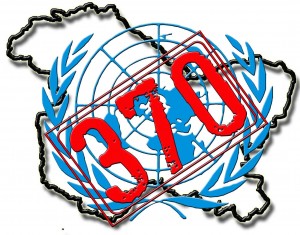 The BJP Prime-Ministerial candidate reviving a debate that calls for revisiting the 1947- something that is considered as an anathema in New Delhi might not have been well taken by some New Delhi based ‘NGO-Intellectuals” and “think tanks”. They have been engaged in deconstructing well entrenched ‘Kashmir narrative; that draws strengthen from the commitments of the Indian leadership at public rallies, in the Parliament and at the United Nations Security Council. Any reference to the 1947- and Kashmir related developments in India, Pakistan and at the international level ruffle their feathers- in fact they are mortally afraid of engaging in a debate on Kashmir dispute outside their briefs. These NGOs and ‘think tanks’ with help of some of their satellites in the University campuses and some colleges have been endeavoring hard to convince some young scholars and pen-pushers that referring to 27 October 1947, and talking about the ‘conditional and provisional’ accession of the state and the United Nations Resolutions on Kashmir, or the Article 370 was not pragmatism and realpolitik. The think tanks and NGOs from New Delhi engaged in Kashmir believe that debates like one kick started by Narendra Modi energize and enrich the ‘peoples narrative” and demolishes the much trumpeted ‘dominant discourse’.
The debate over the article 370 instantly brings host of questions to the mind. How and why this article of the Constitution of India came into being vis-à-vis Jammu and Kashmir. It also calls for a debate on the controversy surrounding the ‘Instrument of Accession’ that provided Raison d’être for this article. Here, I may not to debate the ‘fact and date’ of the instrument of accession- this has been threadbare debated and discussed by eminent historians like Alastair Lamb. Kashmir historians and researchers like Dr. Abdul Ahad and Er. M.S. Pampori has also forcefully challenged the authenticity of this document. Dr. Ahad on the basis of records in the State Archives contests the signatures of Maharaja Hari Singh on the accession document and asserts that these have been faked.
Notwithstanding debate over the ‘fact and date’ of the Instrument of Accession’ but it goes without saying that article 370 of the Indian Constitution in no way endorses the ‘dominant accession theory’ – that accession of the State with India is final. This Article carries a sub-heading, “Temporary Provisions with respect to the State of Jammu and Kashmir.” “Implying that the constitutional relationship between Kashmir and India are to be temporary and transitional.” P.L. Lakhanpal explaining why the relation between Kashmir and India were transitional and temporary writes, “The intention was made clear by Indian Cabinet Minister, Mr. N. Gopalaswami Ayanngar while presenting the article (then 306 A) in the Constituent Assembly on October 17, 1949.
Quoting Ayyanngar a bit in detail is important for understanding, why this provision was introduced with regard to Jammu and Kashmir. Ayyaner had said in the Constituent Assembly of India, “We are still entangled with the United Nations in regard to Jammu and Kashmir with the United Nations and it is not possible to say now when we shall be free from this entanglement. That can only take place when Kashmir problem is satisfactorily settled. Again the Government of India have committed to the people in certain respects. They have committed to themselves to the position that an opportunity would be given to the people of the State to decide for themselves whether they will remain with the Republic or wish to go out of it. We are also committed to ascertaining the will of the people by means of a plebiscite provided that peaceful and normal conditions are restored and impartiality would be guaranteed.” Has this situation changed, no it has not, Kashmir continues to be in the UN and India and Pakistan continue to be engaged in finding a solution of the dispute.
Looking in this perspective at the spirit and the objective behind applying Article 370 to Jammu and Kashmir it was neither introduced as “tunnel” for integrating the State with the Union of India, nor a “bridge” for strengthening accession but as a Constitutional provision for holding a plebiscite in Jammu and Kashmir. It was but for overzealousness of the National Conference that this Article was used as conduit for integrating the State with the Union of India. Notwithstanding, India reiterating its commitment of allowing the people of Jammu and Kashmir to exercise right to self-determination at UN this party held elections for the Jammu and Kashmir Constituent Assembly for determining the ‘future shape of the state with India.’ It managed all the 75 seats of the Constituent Assembly. These elections had invoked pooh pooh from independent commentators and political observers in India and outside. Josef Korbel had aptly said about these elections, “No dictator could do better.”
The very idea of convening the Jammu and Kashmir Constituent Assembly was against the UN Security Council resolutions of 1948-1949. Out of share arrogance Sheikh Abdullah had said Kashmir was not ‘interested in the United Nations and had shown contempt towards the Security Council Resolution. On March 30, 1951 the Security Council affirmed in its resolution (S/2017/Rev.1) that convening of the Constituent Assembly and any action concerning the future of the state would not be in accordance with the previous agreement on plebiscite. Looking at the Constitution (Application in Jammu and Kashmir) order 1954, under 370, Delhi Agreement of 1952, between Sheikh Abdullah and GOI and amendments to order of 1954 from time to time to apply more provisions of the Constitution to Kashmir in the light of 30 March 1951 UN resolution and which was reaffirmed through 24 January 1957 Resolutions by the Security Council all the actions taken under the Article 370 with regard to integration of are not in consonance with the international agreement on Kashmir to which India and Pakistan are committed before the international community.
Let me reiterate, that the words provisional and transitional tagged to this article clearly suggested that this provision of the Indian Constitution will remain there till a plebiscite is held in Jammu and Kashmir and the dispute is settled for ever.


Filed under: Editor's Take