Peace Watch » Editor's Take » Why Sheikh Abdullah Exiled Intellectuals.
Why Sheikh Abdullah Exiled Intellectuals.
PUNCHLINE
Kashmir Intellectuals Exiled to Pakistan?
Z.G. Muhammad
It is ‘power of ideas’ and intellectual inputs that work as catalysts in bringing about political changes. Historically, majority of our leaders from the towering to the dwarfish, have been averse to the ideas and inputs from thinking minds. In fact, after mid-forties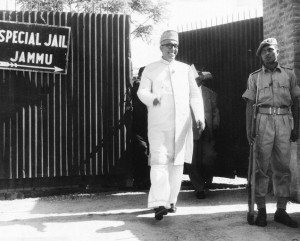 to this day intolerance towards intellectual discourse about the political struggles or the movement has been basic principle of a powerful section of the tribe. People of the state since 1924, have made huge investments in the political struggle. Suffered incarcerations, whippings, lashings and bullets. Hundreds of thousands martyred. Notwithstanding, people offering unprecedented sacrifices, the ninety one year old struggle instead of reaching to logical the gaol, has with every passing day become foggier. One of the important reasons for the goal becoming cloudy has been the role played by leader in suppressing honest and objectives views and denying space to valuable intellectual discourses. And it was but for this attitude of the top leadership that in 1947, when two new independent dominions of India and Pakistan were born Jammu and Kashmir which was an independent state became a dispute territory. Internationally, it got dubious title of “India-Pakistan Dispute.” Few days back, on reading a news item about hospitalization of Ambassador Muhammad Yusuf Buch, a minister in Z.A. Bhutto cabinet, Pakistan’s Ambassador in Switzerland and senior advisor to UN Secretary General in New York I was reminded about this ugly chapter of our history. The 1922, Srinagar born iconic Kashmiri after qualifying KCS in 1947 was posted as top administrator in Uri. In a dinner hosted by a top businessman for Bakshi Ghulam Mohammad, Deputy Prime Minister of Kashmir and prominent Muslim officer in an hour and half long address he frankly articulated his views on the future of Jammu And Kashmir State. His views were not in sync with the views held by Sheikh Abdullah and Bakshi Ghulam Mohammad. He denounced in strong words Maharaja Hari Singh for signing the “Instrument of Accession”. Despite, validity of this document having been challenged by couple of important historian, it brought Kashmir within the ambit of India. Since ideas of this brilliant 25 years old officer were not in sync with the leaders who had entered into a Faustian bond, he immediately became a bête noire for the government installed by the Maharaja at New Delhi’s insistence after landing of Indian troops in Srinagar. Buch once remembering his hard hitting speech said at the officers meet said: ‘Bakshi controlled his anger – Abdullah would have lost his temper and ranted incoherently.’ Few weeks later, he was arrested from his house in early morning hours and along with Molvi Noor-u-Din- a bright mind cleric, Agha Showkat Ali and Barrister Abdul Ghani Renthu was exiled to Pakistan. And never allowed to return to his place of birth. Hundreds of the Muslim Conference leaders and scores of intellectuals which included some important writers and journalist were arrested. From jails they were put in buses and exiled to Pakistan. The new ruling class believed that it had authority from their party cadres. Any intellectual discourse challenging the wisdom of Sheikh Abdullah and his cohorts was denounced as blasphemous. Sheikh Abdullah, even muzzled senior leaders of his Party National Conference pleading for debates on supporting the Maharaja’s decision of joining India. [ZGM1] On
  15 October 1947 a public rally was held at Mujahid Manzil Srinagar to accord reception to the leaders released from various jails after more than one year. These leaders had been arrested by the Maharaja during the Quit Kashmir movement. At this rally with all his eloquence, Muzaffarabad born Molvi Mohammad Syed Masoodi had explained how the sub-continent had undergone a sea change during their detention. He also explained to the workers and supporters of the National Conference, why the party was not now bound by any past pledges that leaders had made to the Congress leadership about joining India. Quoting Masoodi here verbatim becomes imperative, “We should not forget the reality that towering Congress leaders had assured us that India will never be partitioned. It will be socialist country where every region and religion will have equal opportunities. Now same leaders have affixed their signature on the division of the sub-continent without taking us into confidence. So we are not bound by any pledges we might have made about Kashmir becoming part of India. That pledge was for the United India. In changed situation we will have to take stock of the emerging scenario and do some rethinking about joining India and keep partition plan in mind”. Masoodi was not allowed complete his speech. Sheikh Abdullah forcibly dragged him and made him to sit down. There was commotion in the rally. Sheikh Abdullah got up and informed restive crowd that Molvi Syed Sahib had been just released so he was not abreast with latest development. Sheikh Abdullah could not calm people and the public meeting had ended in a chaos. Besides, simmering discontent within the National Conference, the thinking minds and intelligentsia including some Muslim officers were up in arms against the National Conference for supporting the Maharaja’s decision. Sheikh in fact was scared of intellectual inputs and discourses. Thank God he did not execute voice of dissent but only exiled them. Had not Sheikh Abdullah’s administration exiled brightest minds like Yusuf Buch, it would have made an essential difference to the Kashmir narrative. That would have gone a long way in helping in the resolution of the Kashmir Dispute. Seen in right perspective from 1947 till date it is the lack of clarity in the discourses orchestrated by the Kashmir “leaders” that has confused the Kashmir problem. Let me cull some quotations from the writings of Yusuf Buch to illustrate how an intellectual discourse makes a difference and helps in strengthening a strong narrative that ultimately leaders to the resolution of the problem/ dispute. During resounding drum beating about General Musharraf’s four point formula some Hurriyat Conference Kashmir out of total naïveté and misplaced enthusiasm stated that UN Security resolutions had lost their validity. Had there been some intellectual discourse allowed within the Hurriyat Conference and in Pakistan on this formula perhaps such an off the cuff statements would not have been made at all. These statements provided grist to New Delhi’s propaganda mill. ‘No bilateral agreement can overtake agreements concluded under auspices of the Security Council. Yusuf Buch explaining this states, “India and Pakistan have bilaterally signed agreements and /or declarations at Taskent, Simla and Lahore. But to hold that any of these has “overtaken” the agreement they concluded under the auspices of the Security Council” is fallacious on four counts. First, it flies in the face of recognized principle of international law which is stated in Article 103 of the United Nations charter viz: obligation under the charter prevail over obligation under other International agreements. Second, the agreement secured by the United Nations deals specifically with the measures required to resolve the Kashmir problem while the other agreements are silent in that respect. Third, as far as the Kashmir issue is concerned, they do not rise above or fall below the level of duress while at the time the United Nations obtained the agreement which later repeatedly endorsed by the Security Council, neither party was driven to sign on dotted line by defeat or any strategic advantage. Fourth, the people of Kashmir, not having been a party to any bilateral undertakings between India and Pakistan, can draw little satisfaction article 103 of the United Nations charter prevails over obligation under other international agreement, writes, “Any map which deviates from the principle laid down in the primary agreement concerning Kashmir is to be arbitrary in conception and failure in effect.” Though papers and presentation made or articles written by Yusuf Buch have not be compiled by any of the publishers in India, Pakistan or USA but whatever is available in the shape of newspaper they are essential readings for students of contemporary Kashmir. He very subtly deconstructs even the ‘dominant discourses’ carelessly or out of share ignoramuses owned by the “popular” Kashmir leadership.
  On much touted proposal of making LOC a permanent border building stronger discourse against it he writes, “ “This suggestion may have some attraction for the ignorant and the unwary, as well as for those who wish to settle the dispute on India’s terms in a disguised form.”. Kashmir leadership should come out of hackneyed mind set it has inherited from oldies and become tolerant towards intellectual inputs.


Filed under: Editor's Take
“the crisis allowed Abdullah to begin his reign in the way that came naturally to him – as a dictator.
David Devadas (in search of future the story of Kashmir) page-62