Peace Watch » Editor's Take » Can Kashmir Make De Novo to the Security- Debate
Can Kashmir Make De Novo to the Security- Debate
Punchline
Back to Centre Stage
Nawaz Sharif’s speech
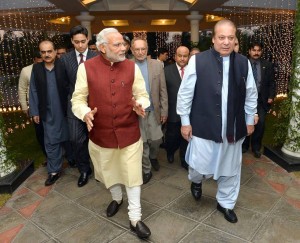
The Prime Minister, Shri Narendra Modi visits the Prime Minister of Pakistan, Mr. Nawaz Sharif’s home in Raiwind, where his grand-daughter’s wedding is being held, at Lahore, Pakistan on December 25, 2015.
It was almost like rolling back the clock when Prime Minister of Pakistan Nawaz Sharif in his address on 21 September 2016, to the United Nations General Assembly talked about the ongoing uprising and the Kashmir Dispute. Out of the allotted time, he dedicated three-fourth of his time to Kashmir problem. His speech was reminiscent of the marathon debates sparked between India and Pakistan representatives on January 15, 16 and 17 1948 on the floor of the United Nations after India had complained to the United Nations Security Council against Pakistan. Moreover wanted Pakistan to be declared as an ‘aggressor.’
In his speech India’s principal delegate, Union Minister, Gopalaswami Ayyangar told the Security Council that ‘India had been compelled to bring the Kashmir question before the Security Council because of its failure to reach agreement in direct negotiations with Pakistan owing to “intransigence” and “cooperation.” On the question of Maharaja Hari Sing acceding to India, Ayyangar told the Security Council that India had “informed the ruler the accession should be settled by plebiscite as soon as peace had been restored.” Pakistan was represented by its Foreign Minister, Zafrullah Khan. Seen in right perspective, the Security Council conceded to India’s proposal made to Pakistan on November 1, 1947. In this proposal Governor-General of India, Mountbatten had suggested to his Pakistani counterpart M. A. Jinnah for deciding Kashmir future by holding a Plebiscite under the supervision of the United Nations. India did not raise any objections to the United Nations passing the resolutions calling for holding a plebiscite in Jammu and Kashmir under its supervision but signed them- thus sanctifying them as international agreements.
Nawaz Sharif’s speech in the General Assembly on Wednesday when he said ‘peace cannot be achieved between India and Pakistan without resolution of Kashmir Dispute’ and referred ‘to people of Kashmir demanding for right to self-determination as promised to them by several resolutions’ was almost a refrain of what Ayyangar and Zafarullah had stated sixty-eight years back on the same floor.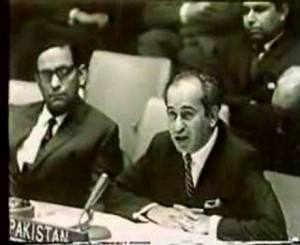
In New Delhi, the speech sounded bizarre and provoked the harshest reaction from politicians and journalist because it was after a gap of decades that Pakistan Prime Minister so loudly spoke about the demand of right to self-determination for Kashmir in the General Assembly. He talked at great length about recent killings, blinding, wounding of children and the human rights situation in Kashmir that and described the uprising in Kashmir as ‘Intifada’ It was New York Times that for the first time had called 2010 unrest in Kashmir in which 116 children and youth were killed as “Intifada” and Indian Author and Novelist Arundhati Roy had popularised the word in the Western media and described it as “new Intifada in Kashmir.” Most of the President’s and Prime Minister of Pakistan in their speeches in the General Assembly for many years had made a casual reference to Kashmir. President Musharraf in his speeches at the General Assembly never called upon the Security Council to implement its resolutions on Kashmir except in 2005. Seeing it faux pa former Foreign Minister Khurshid Kasuri blames Munir Akram, then Pakistan’s Permanent Representative to UN. Kasuri blames Munir Akram for having handed over speech to written by him to the President instead of one prepared by the Foreign Office. Even Nawaz Sharif 2015 speech except lamenting the UN’s failure in implementing its resolution was not detailed as the recent one. In Kashmir for its text and choice of words, Nawaz Sharif speech was compared to Bhutto’s 22 September 1965 speech in the Security Council. In Kashmir it is remembered for phrases, “Kashmiris are our brothers in blood, flesh, and life, our kith, and kin of ours.”
India’s First Secretary in the Permanent Mission of India to the UN Eenam Gambhir exercising its Right of Reply in her six hundred word speech accused Pakistan of sponsoring “terrorism.” Interestingly, she connected Pakistan to international terrorism but did not accuse the country of instigating the 73 days old ongoing ‘Intifada’ in Jammu and Kashmir- something one is familiar with. For the first time in three years, Prime Narendra Modi will be skipping the UNGA session, in his place, it will be addressed by External Affairs Minister Sushma on Monday – the day this column appears in the Newspaper. There are indications that besides advocating for inclusion of India in the NSG and a berth on the big table she will largely focus on Nawaz Sharif’s speech accusing Pakistan of “cross-border terrorism” and attack and fire in an army camp in the border town of Uri that ‘killed seventeen soldiers.’ Such accusation and counter-accusation are a part of the history of the India and Pakistan relation. In fact, India’s January 1, 1948, complaint against Pakistan to the UN Security Council that ultimately earned for people of Jammu and Kashmir right to self-determination to be exercised by them through an impartial plebiscite under the supervision of the august body were not much different than the accusations that were articulated by Ms. Gambhir.
The question arises where would this war of words between India and Pakistan on the floor of the UNGA that have already caused jingoistic discourses end. If it prompts some powerful or friendly country to bring the two countries to the negotiating table. Or it makes New Delhi and Islamabad with the respective stands on Kashmir approach the United Nations Security Council De Novo for helping the two countries to settle the Dispute. (India has been claiming entire state of Jammu and Kashmir as it stood on August 14, 1947, and Pakistan has been asking the Security Council to see its Resolution implemented in letter and spirit.)
 The UN resolution could have been implemented, and Kashmir Dispute resolved long before but for Russia time and again using its veto power against it in the Security Council. Most of the resolution on Kashmir were co-sponsored by the United States. It seems unlikely that the USA and other countries who sponsored or co-sponsored these resolutions can now distance from them 0r oppose them, if Turkey sponsors a resolution seeking DE Novo cognizance’ by UN Security Council of Kashmir problem because of ever-growing tensions between India and Pakistan over this sixty nine year old dispute- a nuclear flashpoint. The resolution could be co-sponosred by China or any other member country of OIC. In the changed global politics, more importantly the balance of power in the region it seems unlikely Russia would use its veto against such a resolution.
First published in Greater Kashmir on 26-9-2016


Filed under: Editor's Take