Peace Watch » Editor's Take » Importance Yusuf Buch’s Writings to Kashmir
Importance Yusuf Buch’s Writings to Kashmir
Punchline
Reading Yusuf Buch
Z. G. Muhammad

I learned two new phrases in the past fortnight that I believe are important to our narrative and need to dwell upon a bit at length. One, ‘life writing’ and another ‘conflict parasites’- the first one I heard from a Kashmiri born novelist Nitasha Koul at the Kashmir University and the second one from a young journalist. The first one gives more power to the narratives of the struggling people and the second one is a chink in the armor of the resistance movement.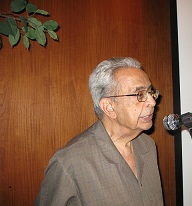
I wrote about the power of ‘life writing’ in my last week column. To get more information about Kashmir related ‘life writing,’ I googled. It took me to a series of article on Kashmir by Eqbal Ahmed, a ‘political scientist, writer and academic known for his anti-war activism, support for resistance movements globally. And also to the presentations and writing of Mohammad Yusuf Buch ( Ambassador M. Yusuf Buch ) a Kashmiri intellectuals exiled to Pakistan by Maharaja Hari Singh’s Prime Minister, Sheikh Mohammad Abdullah few months after the landing of Indian army at Srinagar airport. Buch, the Kalashpora, Srinagar-born alumni of Islamia High School, Rajouri Kadal later in life was an advisor to the UN Secretary-General, Ambassador to Switzerland and Federal Minister of Pakistan.
Yusuf Buch, a KCS officer and a supporter of the Jammu and Kashmir Muslim Conference, was arrested and bundled into a bus with few other intellectuals and pushed into Pakistan near Suchetgarh in Jammu. Other intellectuals who were on the bus included Agha Showkat Ali, Barrister Abdul Gani Rentoo, and Mahmood Hashmi. One of their contemporaries lamenting over Kashmir not having produced any influential speaker, writer or politician to ‘present a sober account of the Kashmir case at the international level as something larger than a territorial dispute’ writes:
“During the period between 1949-1950, there were at least three bright young Kashmiri activists who held out a lot of promise to emerge as exponents of their case at the intellectual level like Palestinian intellectual Ghada Karmi. They were Yusuf Buch, Mahmood Hashmi, and Agha Shaukat Ali. They had all the makings of committed revolutionaries endowed with the gift of persuasive speech and simple, well-reasoned writing and, above all, the advantage of youth.”
Mahmood Hashmi who in 1947 was a Professor at the Amar Singh College, Srinagar wrote a memoir and couple of books in Urdu on the Kashmir problem. True, Yusuf Buch did not write any memoirs or books. Nonetheless, his presentations at various international conferences and forums and writings in journals and newspapers if compiled will not only enrich the Kashmir narrative but will also serve as a lodestar for the future generation to guide them through a complex matrix of the Kashmir Dispute.
Every speech or piece of writing of Yusuf Buch comes up with an answer for the questions raised as an alibi for procrastinating the resolution of the Kashmir Dispute and maintaining the status quo. On many an occasions ‘intellectuals’ in India and Pakistan high on rhetoric have been talking about a road- map on Kashmir outside the realm of the right to self-determination. In one of 2004 presentation, Buch has an answer for this. To quote him: “Any road-map which deviates from the principle laid in the primacy agreement concerning Kashmir is bound to be arbitrary in conception and failure in effect.”
During the peace times in some political circuits of activists calling themselves as friends of Pakistan or India the pep talk often is that the resolution to the Kashmir Dispute lies in some ‘give and take.’ M. Yusuf Buch has an appropriate take on this subject:
“The question arises here: if Pakistan is not to be pressed to surrender its position on this issue, why should India be? The answer is that neither of the two has to surrender: both have to respond to the common interest of their people and return to the rational position each originally took when they brought the issue to the United Nations. Their shared position was that the future status of Jammu and Kashmir should be determined by the will of the people (equally important) that should be ascertained under impartial auspices without coercion or intimidation from either side.”
In 2005-06, many a “political personalities” from Kashmir chose to walk into a booby trap discourse of the ‘porous borders without changing them.’ Yusuf Buch saw the phrase ‘borders cannot be redrawn’ coined in this context by Prime Minister, Manmohan Singh as ‘appearing soothing but, in effect calling for not settling the dispute but embellishing the status quo.’ In a terse prose, he explains it further: “Borders cannot be redrawn, it is said. When were they legitimately drawn? If they are to be, in the Indian Prime Minister’s words, “just lines on a map,” they should be easily changeable in the interests of peace and concord. We can see that his language represents the sheep’s clothing on the intransigent wolf.”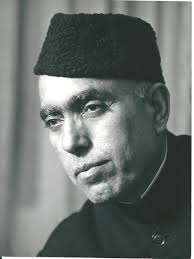
Since 1955, when the Plebiscite Front was established ‘political personalities’ of Jammu and Kashmir have been looking at the UN resolution as one of the modus-operandi for the settlement of the problem. They never saw the UN resolutions on Kashmir as an international agreement equally never talked about dynamics of their non-implementation. Buch in a paper titled, ‘Kashmir the Festering Wound’ with all subtlety and sobriety tells us how non-execution of UN resolution is a total disregard of an international agreement:
“Once two parties signify their unreserved acceptance of proposals jointly submitted to them regarding their mutual dispute, they enter into an international agreement governing the settlement of that dispute. The agreement becomes more binding when the rights of a third party–a whole people—are involved. There can be no two opinions that adherence to, and fulfillment of, international agreements is one of the essentials of a stable international order. Nothing but chaos would be the world’s lot if this principle were cast aside.”
There are lots of serious writings on the Kashmir Dispute, like that of Eqbal Ahmed and M. Yusuf Buch that are yet to be compiled and published as books or have escaped the attention of researchers. Such works, whether published in India, Pakistan or any other part of the world are an intrinsic part of the Kashmir narrative. They need to be disseminated and preserved for the posterity. So far Kashmiris living on the both the sides of the LOC and other parts of the world have not institutionalized their narrative by setting up an institution like the Institute of Palestine Studies.


Filed under: Editor's Take