Peace Watch » Editor's Take » Trump and Mediation of Kashmir Resolution- A Moot-point
Trump and Mediation of Kashmir Resolution- A Moot-point
Kashmir Back In Washington Discourse
By
Z.G. Muhammad
The majority of people of J&K of late have become highly skeptical about the US role in the resolution of Kashmir. This skepticism was all time high when reports about President-elect Donald Trump’s interest in mediating a resolution of Kashmir were published in the newspapers. Notwithstanding, skepticism, whenever there is a presidential election in the only superpower on the globe every one of us from the man in the street to intelligentsia on the University campus’ intensely follows the campaign to find out if Kashmir is mention in it.
Looking towards Washington for the resolution of the Kashmir is not out of wishful thinking, it is not out of what Christopher Brooks called as “the fantasy cycle” but rooted in the history of the Dispute. From the birth of the Dispute, in October 1947, Kashmir has topped the Washington’s South Asian policy. For first two decades after the UN through its resolutions guaranteed right to self-determination to people of the State three US Presidents Harry S Truman, Dwight D Eisenhower, and John F Kennedy got ‘personally involved’ in the resolution of the Dispute. True, the later Presidents did not show same enthusiasm as by their predecessors. Nonetheless, they continued to nudge and encourage the two countries to settle the Dispute for ensuring peace in the South Asian region. Moreover, they played a pro-active role in defusing the crisis sparked over Kashmir between the two countries.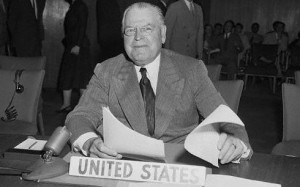
In the post-1989 scenario in Kashmir, Washington once against forcefully reiterated stand it had taken in the fifties on the Dispute. It made various attempts to mediate for resolving the problem, to quote Herald Tribune, “switched from an overt to a quiet, behind-the-scenes role as peace broker.” President Bill Clinton passionately sought to see two key South-Asian nuclear players resolve the core issue and live in peace. As an Indian commentator has written his ‘fixation on Kashmir was apparent in his speeches’. Comparing Kashmir to Caucasus in his September 1993 at UN General Assembly he saw it as a ‘serious threat’ to the world peace. He called it a most dangerous place in the world. He made India and Pakistan Prime Ministers sit at the table in Lahore in 1999. President George W Bush also did not lose sight of the dangers for the peace in the non-resolution of the Dispute. On February 22, 2006, he strongly advocated the primacy of the people of the state in the resolution of Kashmir and tacitly supported the right to self-determination. In his words “the United States supports a solution of Kashmir dispute acceptable not only to India and Pakistan but also to “citizens of Kashmir.” The statement highlighting pre-eminence of people of the state was made at a time when India and Pakistan were in the thick of dialogue, and widely it was believed that the two countries had reached an agreement – and it was just to be signed.
How Obama Administration had seen Kashmir as a gateway to peace in Afghanistan and South Asia many columns were written in the past. Even on a date, with Washington having installed a government in Kabul peace in Afghanistan is as fragile today as it was during the first term of Obama when Richard Halbrook was appointed as Special Representative in the region. It is a harsh reality unlike many past presidential elections in the US as was rightly pointed out by Foreign Policy magazine neither Democratic nor Republican candidates mentioned Kashmir during their election campaign. Unlike the past elections, in the 2016 election, the candidates were more focussed on domestic issues, and foreign relations were almost relegated to the background- so it would have been naïve to expect Kashmir mentioned in the campaign. Nevertheless, given to brittleness of peace in Afghanistan, bitterest relations between two nuclear powers, and China emerging as a superpower, the state cannot be off the US radar. So, the Dispute mentioned in the Trump- Nawaz Sharif telephonic conversation and it making a buzz in the world media was not a surprise.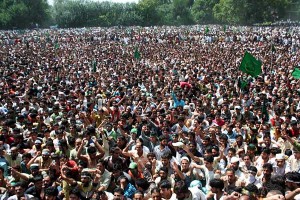
The PMO in Islamabad did not earn credit for issuing the transcript of the conversation to the media at home and abroad. Some cast doubts on the veracity of the conversation, and some interpreted it as a disaster. Whether, making it unilaterally public was in keeping with the diplomatic protocol or not but it did bring Kashmir back to the Washington’s South Asia Discourse- perhaps can make it even to its policy in the region.
Mike Pence, vice-president elect, talking in NBC News, ‘Meet the Press’ on December 4, gave credibility to the perceptions that one gathered from the transcript of the conversation. Talking to Chuck Todd, the vice-president-elect subtly provided insight into the Donald Trump’s interest in engaging in Indo-Pak relations and readiness to play a role in the resolution of issues- of course, Kashmir. Replying to Todd, Pence said, “Well, clearly there’s been great tension between India and Pakistan in recent days. It’s resulted in violence along the Kashmir region. And I think what the president-elect expressed in conversations with leaders of both countries was a desire for continued US engagement on building the relationship with both of those countries. These are two nuclear powers–”. Replying to a specific question on the mediating resolution of Kashmir, Pence said, “But I think you’re also going to see an energetic leadership in the world, prepared to engage and to look for ways that he can bring those extraordinary deal-making skills to bear on lessening tensions and solving problems in the world.”
Given to statements of Donal Trump during the election campaign, there is every reason for the commentators to keep their fingers crossed. Nevertheless, it is possible despite a strategic partnership with India like Kennedy he also sees “a resolution of the India-Pakistan dispute over Kashmir as essential for countering China.”
Published in Greater Kashmir 12-12-16


Filed under: Editor's Take