Peace Watch » Editor's Take » Why Appointment of Pakistan Army Chief Is A Global News?
Why Appointment of Pakistan Army Chief Is A Global News?
 Punchline
What Is Big In It?
Z. G. Muhammad
I have no idea about the general masses. Nevertheless, for over one and half year Pakistan media was breathlessly waiting for November 29, 2016. Some columnists, harboring fears about another military rule suffering from a sort of Tourette’s syndrome consumed reams of papers analyzing if the Chief of Army Staff, General Raheel Sharif appointed in November 2013 will bid adieu to his office on the due date. Sparing no opportunity to put the army of their country in the dock during the three years term of Raheel Sharif, some columnists more than three times saw another military coup against PM Sharif on the cards. Moreover, as and when the containers of Imran Khan and Canadian cleric blocked the roads, some prominent newspaper splashed headlines denouncing the opposition leaders as the proxies of the army. Some Pakistani columnists like Ayesha Jalal out rightly opined that it was Raheel Sharif and not Nawaz Sharif who was holding key for relations with the neighboring countries. Calling Raheel Sharif as the ‘Real Sharif.’ Commenting on India-Pakistan relation in the Indian Express on September 24, 2016, subtly diminishing the role of the civilian government she wrote, “Perhaps there is a need for Pakistani generals and Indian politicians to think carefully about an out of the box approach to resolving the unresolvable.”
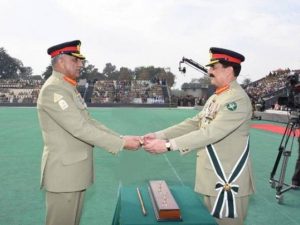
Finally, the wait of the media was over, General Raheel Sharif living to his commitment not seeking any extension chose to fade away into retirement, by starting retirement tours in advance and passing the baton to Qamar Javed Bajwa, 16th army chief of Pakistan. Some columnists described his retirement, ‘good for him, for the army and the country.’ For the Operation Zarb-e-Azb and successfully fighting terrorism even cynics in media hailed him. Of all the 15 army chiefs of the country, Sharif’s was oldest to be appointed to the position at the age of fifty-seven. General Ayub Khan, 42 first native was the youngest general to be appointed to the top position. So far he has been the only general in Pakistan who was praised by politicians and media on his retirement. The most ostensible reason for giving a heroic farewell to him was for his strictly abiding by the constitution and opportunities unlike four of his predecessors deciding not to grab the power. As rightly pointed out by a Pakistani newspaper, ‘If all of his predecessors had stuck to their normal tenures the country would have had at least 24 Army chiefs against only 15’.
In most of the countries across the globe, the retirement of an Army Chief is a routine affair that rarely makes a big news worth reporting. So far in India 26 – four-star generals have taken over as the army chiefs of the third largest army in the world, but these changeovers at best made a single column front page or two column inside page news. The transition is always so smooth that it hardly causes a discussion on the satellite televisions at prime time- it is not a subject for discussions even in TV studios that for their ultra-nationalism are know as “war rooms.”
That given to the history of four martial laws and generals staying in offices beyond their tenure, the smooth passing of the command baton by General Sharif making big news in Pakistan is understandable. Nevertheless, the question that calls for an answer is why the change of an Army Chief in Pakistan makes a lead story in top newspapers and stirs debates across the globe. From New York Times to Guardian to newspapers in New Delhi, the news about the retirement of General Raheel Sharif was covered and commented upon across the globe. Pakistan is a nuclear country, but it is at the seventh position so far as the strength of its army is concerned, then what made a change of its chief of the army a big story for the world and caused statement from some powerful countries?
Most of the Pakistani commentator often write that the founder of the country envisioned a political system ‘that establishes the supremacy of civilian government over the army and did not wish it to be a ‘security state.’ It could be true. Nonetheless, it was right in 1947 that Pakistan’s foreign policy came to grips with the reality of challenge to its right to peaceful co-existence.’ As Agha Shahi writes, ‘Failure of the United Nations for the settlement of disputes, in conformity with principles of international law and principles of natural justice, made Pakistan think to ameliorate the situation.’ ‘Jinnah was convinced that the Dominion of India wanted to throttle and choke Dominion of Pakistan. Jinnah was convinced that if General Gracy had obeyed his instructions of sending troops to Kashmir, the history of the sub-continent would have been different. For not obeying the orders of Jinnah General Messervy and General Gracy were made to pack and go. Nevertheless, these developments followed by the absence of political leadership after the death of Jinnah and assassination of Liquate Ali Khan increased existential threats and sharpened ‘security concerns’ first in Karachi and then in Islamabad. It were threats from the neighborhood as Agha Shahi writes that made the country ‘to look outwards for friends and allies to support its efforts for strengthening the security.’
These concerns instead of diminishing with the passage of time for its geographical location became more prominent and stronger- thus a strong army. For the world, Pakistan has significance for its strategic location –on ‘the cusp of Middle East, Persian Gulf, Central Asia, South Asia and more particularly its relations with China. It has gained further importance after the opening of the China–Pakistan Economic Corridor (CPEC). That has attracted the world in general and regional countries in particular. For their development, the regional countries want to see peace in the region. The two important issues that continue imperil peace in the region are the situation in Afghanistan that continues to volatile and the non-resolution of the Kashmir Dispute.
The Pakistan army will continue to generate interest in the world capitals and international media till peace is ensured in entire Afghanistan, this cannot be achieved by just installing a government in Kabul on props and till the Kashmir Dispute is settled peacefully.
Published in Greater Kashmir on 5-12-2016


Filed under: Editor's Take