Peace Watch » Editor's Take » Steel and Surprise Diplomacy and Kashmir Dispute
Steel and Surprise Diplomacy and Kashmir Dispute
Kashmir in the New Bonhomie
Z. G. Muhammad
It is now ‘surprise-diplomacy at play in India and Pakistan relations. The new-found bonhomie between Prime Minister, Nawaz Sharif and his Indian Counterpart Narendra Modi is throwing one after another surprise. Ostensibly, the Friday surprise was the pleasant one. In a surprise move, Narendra Modi after his meeting with Afghanistan’s President Mohammad Ashraf Ghani and addressing the Afghanistan Parliament stopped over at Lahore for a meeting with Nawaz Sharif.
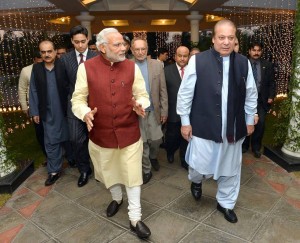
The Prime Minister, Shri Narendra Modi visits the Prime Minister of Pakistan, Mr. Nawaz Sharif’s home in Raiwind, where his grand-daughter’s wedding is being held, at Lahore, Pakistan on December 25, 2015.
India Prime Minister visiting Pakistan has been a rare phenomenon. The visits can be counted on the fingertips. Nonetheless, this one has been the rarest in as much as no India Prime Minister has ever visited Islamabad impromptu. Nonetheless, if the visit had been planned in advance and were part of the secret moves initiated by a go-between, Sajan Jindal, a steel magnate of India and friend of Nawaz Sharif’s son who is also in the steel business not need not to be talked about in this column. There are lots of instances where journalists, writers, and industrialists have worked as a go-between the warring countries.
Where will these surprises end? The duo has left political pundits and foreign affairs wizards guessing on two counts. One, what has been the reason for the paradigm shift in Narendra Modi’s policy towards Pakistan? That many in Islamabad and New Delhi see as a change of heart. The Modi government’s Pakistan diplomacy over the last one-and-a-half years was aggressive and incoherent. First it called off talks with Islamabad because of Pakistan envoy meeting the Hurriyat leaders- something that had been in practice for over two decades. ‘Then it said it wouldn’t have talks until Pakistan acted on terror, and then it stated it would only talk on terror, and then all of a sudden walked to Nawaz Sharif in Paris informed him about New Delhi readiness for talks.’ Then restarted a comprehensive dialogue process covering all issues including the Jammu and Kashmir. Two, can this bonhomie translate into the resolution of the core dispute that has been the cause of wars and mother of all other issues between the two countries? Or it has been initiated for short term gains like New Delhi looking for being a member in the Afghanistan-Pakistan Transit and Trade Agreement (APTTA) signed in 2011. That would allow the entry of containers from Afghanistan into Atari through the Wagah border and station. To quote Nayanima Basu, “This will help India expand trade ties with Afghanistan through seamless connectivity and enable New Delhi to have a greater say in the trading system of the region.” (Hindu) The issue was also raised by External Affairs Minister Sushma Swaraj during her recent meeting with Nawaz Sharif and Sartaj Aziz. And apparently the issue had also cropped up during Modi-Ghani talks in Kabul. There were indications towards this in Modi’s speech in the Afghan parliament where he urged closer cooperation between India and Pakistan for the progress of Afghanistan.
If the issue of the ‘transit and trade’ was issued discussed when two Prime Minister met in Nawaz Sharif’s palace in Lahore has not been made public. India and Pakistan have maintained a discreet silence about the talks between two prime ministers. Pakistan Foreign Office spokesmen in a statement issued after the talks, in fact, said nothing other than the routine rhetoric that the two prime ministers ‘agreed to continue the process through bilateral dialogue.’
Ostensibly, for India and Pakistan is starting 2016 is starting at a positive note. On Friday Pakistan, Foreign Secretary reconfirmed that the stalled foreign secretary-level talks between the two countries are could be held in the second fortnight of January. A couple of days back, Nawaz Sharif’s adviser on foreign affairs Sartaj Aziz informed the media that his country had proposed to India middle of January for talks at the level of foreign secretaries to ‘discuss all outstanding issues. In all likelihood talks are to be held in Islamabad. New Delhi is yet to confirm the date and venue for the proposed talks. Or if the talks will be held at some neutral venue like those of secret talks between National Secretary Advisors held in Bangkok.
The proposed secretary-level talks will be first in the renewed peace process renamed as the “Comprehensive Bilateral Dialogue.” Earlier the peace process with all its troughs and crests was carried out under the banner of the “Composite Dialogue”. The word “bilateral” incorporated at the behest of New Delhi in new banner has casts doubts about the process in as much as taking the Hurriyat leaders on board before initiating Kashmir related dialogue. The resumption of stalled talks after six-month hiatus are seen as a positive development. Nonetheless, the resumption of talks has raised an important question if the two countries have addressed their differences that had caused cancelation of first-ever NSA-level Stalks in August 2015. India had drawn a red line for NSA talks and asked Pakistan not to meet the Hurriyat leaders before the talks. Pakistan had not agreed to pre-condition resulting in the breakdown of talks. It seems that Nawaz Sharif in his reconciliation mood is not interested in allowing nitty-gritty about Kashmir is undermining the bonhomie with Narendra Modi- who interestingly is now seen Nawaz Sharif’s family friend. Sharif has gagged his ministers not to make anti-India statements that can affect the recently resumed peace dialogue, according to a media report.
There are sufficient pointers suggesting the Nawaz Sharif government having agreed not to cause an embarrassing situation for Narendra Modi by holding any kind of consultations with the Hurriyat leaders and inviting them to Pakistan High Commission for talks before talking to New Delhi. The joint statement does mention Kashmir. However, the question remains, if the mention is ritualistic or the two countries will seriously to address the resolution of the dispute will be too early say. So far there is no seriousness in sight and a minuscule section in Pakistan has been suggesting to go ahead without Kashmir.
“It is incredible” as rightly said by Ambassador Yusuf Buch, “that anyone should fancy it wisdom to prescribe the perpetuation of disease as a remedy.”
The writer is a Srinagar-based columnist and author of Kashmir in War and Diplomacy.


Filed under: Editor's Take