Peace Watch » Editor's Take » Litmus Test For Pakistan
Litmus Test For Pakistan
Punchline
Fears of Leaders?
By
Z. G. Muhammad
‘The solution of Kashmir Dispute is rooted in India and Pakistan friendship.’ For past sixty-five years, this euphemistic sentence has been so often dinned into our ears that it has become part of psyche people and leadership. And whenever, India and Pakistan dialogue started, it generated a lot of euphoria in our leadership, and from the dwarfish to the tallest, every leader has hailed it with high expectations. There is hardly an instance when leaders before issuing the statements have tried to analyse the semantics of the joint statements or phrases incorporated in them. And if these were not defeating or diluting the cause of the people of Jammu and Kashmir.
Some years back, in this column, I endeavoured to explain how the choice of language is important in political discourses. Moreover, how a cleverly used single phrase in a statement or joint communique or an agreement that otherwise reads to us well-intended changes the whole context or subverts the people’s narrative. I had also tried to explain the political and diplomatic dynamics of the phrases like “separatists” and “separatism” and how some important organization ‘advocating the right to self-determination’ by using these words in their statements had ‘inadvertently’ been sucked into the hegemonic discourse. For explaining how a single phrase changes the whole context of a bilateral or an international agreement, in my opinion, the Simla Agreement is one of the best examples. In 1971, dreams of founding the father of Pakistan had been wrecked. ‘The country was divided and diminished.’ To sort the post-war problem, India and Pakistan leaders met a Simla. India team wanted to discuss Kashmir. Pakistan being in bad bargaining position did not want to talk Kashmir, it only wanted to sort problems resulting from December 1971 war. Nevertheless, it was at India’s insistence that Kashmir was made part of deliberations. For Kashmir and India’s “demand for the legitimization of the ceasefire line as international border,” the dialogue got protracted and caused exchange of many draft agreements. And finally, it was the magical phrase, “without prejudice” in the clause four of the agreement’ that left the stand of Pakistan on Kashmir intact. That “the Kashmir question has to be resolved in accordance with relevant UN resolutions.”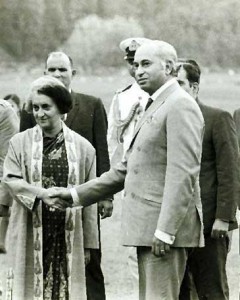
In this column, the Simla Agreement was referred to only to make a point how a single phrase can change the whole context. Since early 2014, when Pakistan Prime Minister Nawaz Sharif was also invited to oath taking ceremony of Narendra Modi along with heads of other states, Islamabad has been enthusiastically looking for better and strong ties with New Delhi. Compared to Islamabad, New Delhi has been lukewarm- with a purpose. It wants ties with Pakistan on its own terms and conditions. And by and large, New Delhi has succeeded in achieving its objective. The glaring example in this regard was the joint statement issued by the two countries on July 5, 2015, after a meeting of Narendra Modi and Nawaz Sharif on the sidelines of Shanghai Cooperation Organisation (SCO) in the Russian city of Ufa. The joint statement had not mentioned Kashmir, it only pledged to address issues concerning terrorism. Something that New Delhi had been asking for. The Ufa statement was seen in Pakistan as the biggest diplomatic fiasco. It had ruffled feathers in the establishment and put a question mark on the Nawaz Sharif Kashmir policy. Notwithstanding, the Sartaj Aziz explanations the aftershocks of the Ufa fiasco continue to hound the PML (N) government. To offset the fallout of the Ufa failure, Islamabad once again brought the Kashmir Dispute into focus international focus and raised the issue in international forums. Dr. Maleah Lodhi, Pakistan permanent representative forcefully raised the Kashmir problem in all UN forums. On December 17, 2015, External Affairs Minister, Sushma Swaraj informed Raja Sabha that Dr. Lodhi had recently written three letters to the President of UN Security Council which referred to Kashmir and asked the top decision making to take note of the situation along the LOC. If New Delhi agreeing to the resumption of dialogue could be attributed to these developments or nudging from the US would be just at this juncture only a surmise. Nonetheless, the question arises are these talks going to make any difference to people of Kashmir and ultimately help in the resolution of the Kashmir Dispute.
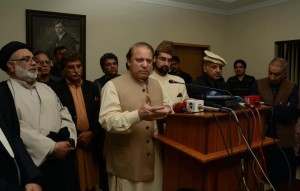 The mention of Kashmir in the joint statement issued on Dec 9 by Sartaj Aziz, Pakistan prime minister’s adviser on foreign affairs, and India’s External Affairs Minister Sushma Swaraj was seen as a welcome sign by Kashmir leadership. Most of the leaders issued statement hailing the new peace process. Nonetheless, the majority of the leaders’ and analyst did not realize the implications of the word “Bilateral” in the middle of the “Comprehensive Dialogue”, and how it not only diminished the role of Kashmiri in the process but totally refused. “By injecting one word bilateral, India has stumped Pakistan and has succeeded in excluding APHC or any such entities, observed a senior Pakistani analysts, “the Kashmiris are excluded as a party to the dispute. Nawaz has once again let down the Kashmiris.” “Watch out on the letter B in the title. A shrewd repeat of Ufa to exclude Kashmiris from the dialogue.” Another Pakistani analyst has observed. So the fears of some Kashmir leaders about dialogue are not uncalled for. In past week column, I had posed the question if redlines for Hurriyat meeting Pakistan leaders before Secretary Level talks will continue.” From the statement of the spokesperson of MEA, it is clear the Hurriyat and other leaders are out of the game. Moreover, the narrative for maintaining status quo has been set into motion, first Farooq Abdullah repeated his favourite suggestion of converting LOC into the permanent border and now Mufti Mohammad Syed suggested creating crossing point like Wagah along the working boundary. Thus subtly pleading status quo.
However, the litmus for Pakistan Kashmir policy will be when Foreign Secretaries of India and Pakistan meet in coming days.
Published in Greater Kashmir 21-12-15


Filed under: Editor's Take