Peace Watch » Editor's Take » Leaders Vs People – A Debate
Leaders Vs People – A Debate
 PUNCHLINE
People in Dock
Z. G. Muhammad
The birth of new discourses, in a kind of political struggle we are involved in, is a natural corollary. During past sixty-seven years, discourses have been galore in our state. To invade popular narrative hegemonic discourses have been conjured to wilt the struggle of people. There also have been occasion, when people were blamed for failing the leadership in ‘translating their vision into reality’ and alternative narratives totally in conflict with the people narrative were manufactured.
Today, once again people have been put into the dock. And have been accused of betraying their own cause. There can be no denying as Edward Said has put it ‘key is with the people’ for a success of a political struggle. Nevertheless, to understand, if people of Kashmir have betrayed their own cause at any point of time, one needs to take recourse to the history of the freedom struggle of Kashmir both before and after 1947. Let may say without fear of contradiction. That throughout our struggle, it is the people who have been the protagonists of all the movements. It is they who have stood like a rock for their cherished cause, suffered and sacrificed their lives for it.
In sweltering summer, on 6 July 1847, less than one year after the infamous Amritsar Sale deed, it was thousands of people from Srinagar who had revolted against the Dogra rule and marched via Shopian toward Lahore one of the power centres of the British imperialists. And on the assurance of Lt Rendell Taylor envoy of the British Resident in Lahore, postponed the march. So is true about the 1865 and 1924 uprisings. These were not inspired or led by an established leadership or elite. The protagonists of these movements were none but the resilient Kashmiris. On 13 July 1931, people had not gathered outside the central jail at the bidding of leaders but on their own. No leader was present on the spot. It was but for the happenings outside the Central Jail that Kashmir cause earned the sympathisers across the subcontinent, caused ripples in the office of the Viceroy of India and resulted in the appointment of the Glancy Commission.
Historically, people never failed to respond to the clarion calls of the leaders but it has been the inept handling of the leadership or their expediencies or vested interest that caused even most the powerful movements to burst like a soap bubble. Is it not historical reality that in September 1931, leadership gave a call for Jihad against the autocratic and discriminatory rule and people armed with, whatever weapons they had gathered in thousands at one place. Received initial training in weapon snatching at Khanyar. Nonetheless, leadership after intimidation by the Maharaja lied to people and asked them to withdraw. Had not then leadership done so the Dogra rule would possibly have ended right in the thirties only? And history would have taken a different course. There are a plethora of instance when people rose to the occasion fought battle royal against oppression and launched effective movements for achieving their goals but for the faulty understanding or expediencies of leadership these movements fizzled out giving birth to the Kashmir tragedy.
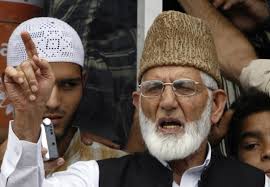
In this column, it is not possible to encapsulate the whole history of events from 1945- 1947, in the subcontinent that had a direct bearing on Jammu and Kashmir and how people were failed by leaders for their faulty understanding and expediencies. Coming to the recent discourse brought into the public domain by a topmost leader. That ‘people had failed leaders by not paying heed to their calls for boycotting the polls. It was weakness of people and this failure should not be attributed to the leadership.’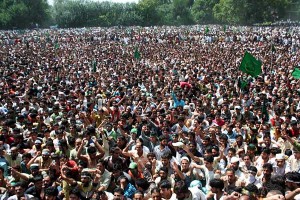
In this column, I am not joining the debate kick-started by some people on social media, ‘if participation in elections was justified at one point of time, when people were engaged in pursuing their goal of right to self-determination as much as they are today, how is it not justified today.’ Nonetheless, there is a fundamental flaw in the premise that people have not been heeding to the election boycott calls of the leadership- it is historically incorrect.
In 1989, Parliament elections people overwhelmingly responded to the election boycott and internationally these elections were seen as the farce. In 1991, fresh elections were held for Indian Parliament, Jammu and Kashmir were excluded from these and Indian Parliament had to amend the law for this. No elections were held for the Assembly also. In 1996, elections for Parliament and Assembly were held in the state. How and why New Delhi gained the confidence to hold these elections in the State is yet another question that calls for revisiting the role of some resistance leaders during 1993-1996. Their backdoor meetings not only with the intelligence agencies or interlocutors from New Delhi but including former Prime Ministers like V.P. Singh in Srinagar. The Hurriyat leadership asked people to boycott these elections and launched an intense and sustained campaign in this regard. People overwhelmingly boycotted these elections. Hurriyat Conference at this juncture was largely unanimous in its resolve to boycott these polls. The US Ambassador Frank Wisner, who camped in Srinagar for a week failed to persuade Hurriyat to partake in these elections. The Hurriyat leadership refused to oblige the American Ambassador. Despite, the National Conference winning 57 seats out 84 seats, these elections were internationally recognized as ‘election at the gun point’. These were seen as a military exercise in which even the State government employees were not involved and whole election machinery had to be brought from outside the state. Even then Chief Election Commission in his book “Dying Terrorism” has tacitly admitted New Delhi’s failure to get cooperation from the people. History has recorded 1996 election as another sham election in the electoral history of Kashmir. The question is if people did not “fail” leadership then, why they should have failed them in 2008 or 2014 election by not completely responding to their boycott calls.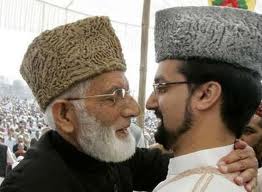
This is a very complex question that calls to be analysed in light of developments before and after 2002 elections. Immediately, after 1996 elections there was rethinking in a faction of the Hurriyat Conference about these elections. They openly articulated their dissenting views and even made public statements. In Jan 2001, talking to Henry L Stimson Abdul Majid Dar, Operational Commander of HM had clearly stated that he would ‘support free and fair elections in the state.’ His role did not end up there, but the presence of his cadres were discernible during the 2002 elections. The questionable role of a ‘religious-political’ party affiliated to Hurriyat during the elections cannot be overlooked. For understanding the participation of people in 2008 and 2014, the role of this cadre-based organization that had emerged as an influential organization during the “armed struggle” needs to be analysed thoroughly. Then the role played by Pakistan leadership recognizing the NC and PDP as stakeholders to the Kashmir dispute by extending an official invitation to them. Both the Azad Kashmir leadership and Pakistan government giving a red carpet reception to Omar Abdullah and extending the welcome to Mehbooba Mufti.
Before, we accuse people of Kashmir betraying their cause, let us look at 2014 elections from the prism of developments in the resistance camp from 2014 we will get an answer.


Filed under: Editor's Take
If a leader is not accepted and endorced by the people what so ever issue is simply means he had loss the faith among masses if vote is not only the meascuring rod however It is abseltly irrelevent to debate that who failed whome becuse in subjugation the might prevails and elections has no relevence as per Unite Nations resolutions.If resistence is only the name of bycot or not to bycot, then one should think that the resistence of Kashmir has no leadership becuse it is leader who leads not the masses so simply he shall be having fingures on the pulse of people.When any one fails to acheive then he balmes on others is simple natural phenomina…