Peace Watch » Editor's Take » Kashmir Leaders Engagment With Ram Jethmalani
Kashmir Leaders Engagment With Ram Jethmalani
Ours is not an arid land. Therefore, there are no natural dust storms. However, it needs no gusty wind to cause a political storm in our state. So much of political dust has gathered during past sixty-three years that even a visit-with-purpose by political leader from New Delhi is sufficient, if not cause a storm but raise the dust. One such recent visit was by a former Kashmir Committee Chairman, B.J.P leader and leading lawyer of India Ram Jethmalani.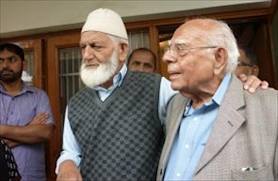
On the face of it was a professional visit. The leading lawyers was in Srinagar in connection with some Kashmir related cases that he and his team were pursuing in the Supreme Court of India and other courts in Delhi.
Leaders, civil society members and human rights activists visiting Kashmir often meet the Hurriyat leaders. Mostly these leaders and civil society members include those who at one or the other point of time have had the GOIs official or unofficial mandate to talk to them. The visits that apparently look courtesy calls many a time are exploratory in as much as understanding the mindset of Kashmir leaders. Often the meetings with the leaders end up at sharing of finely tuned notes on not being ‘captive of the reference points of Kashmir dispute such as 1947 and 1948, UN resolutions,’ ‘changed geo-political situation”, “changed ground realities”, “Normalization” and the “pragmatic approach” needed by Kashmir leaders thereof.’ Notwithstanding Jethmalani, team making it clear that they had no mandate from the GOI or by any political party to work out a ‘compromise’ formula with the Hurriyat leaders, the visit left a trail of dust behind.
The visit would have been a single column city page news item but for the statement given to a local newsgathering agency by the Chairman of now defunct Kashmir Committee it made headlines. The statement said:
“The Hurriyat leaders were ready to make some compromise to reach out solution on the Kashmir ‘dispute.”
“Unless extreme positions from both the sides were not abandoned, no solution to the problem could be arrived at.”
“Majority of the people in Jammu and Kashmir want a peaceful solution for this a compromise on for this a compromise on the respective stands is inevitable.” there was no way other than to shed the tough stands from all sides including Pakistan if any consensus was to be arrived at”.
“If a hardliner like Geelani Sahab sits with me to talk Kashmir problem it must be seen as an indication that there is a scope of compromise on certain issues from the separatist camp.”
There was another story in a local newspaper about Mr. Jethmalani having suggested to the Hurriyat leaders to work in tandem with PDP leader Mufti Muhammad Syed for pursuing the PDP agenda of the self-rule.
Mr. Ram Jethmalani during his two-day visit to Srinagar besides meeting Syed Ali Geelani had meetings with Chairman Hurriyat Conference (M) Mirwaiz Muhammad Umar Farooq, separate meeting with Shabir Ahmed Shah, Nayeem Ahmed Khan, Javid Mir and Zafar Akbar Bhat and PDP leader Mufti Syed. Mirwaiz Umar denounced the report about Jethmalani suggesting him supporting Mufti Syed as “humbug” and an ‘embedded story”.
Largely there was nothing new in the statement made by Mr. Jethmalani. If one looks at the much-trumpeted four-point formula of Pakistan President, General Musharraf, it was a climb down from Pakistan’s stated position on Kashmir. In many words, the formula was a ‘compromise’. That had received assent from a section of the Hurriyat leaders. Some of them to this day look at the formula as the only way forward.
In 2004 when Musharraf had shared the formula with Kashmir leaders contrarily, Geelani had opted out of the loop. He had opposed the formula. Moreover, denounced it as ‘cheating Kashmiris of the right to self-determination’.
The statement attributed to Jethmalani put none other than Geelani in the dock and whipped up a controversy not of his making. Despite Jethmalani, denying the statement about Geelani attributed to him it called for a three thousand-word article by Altaf Ahmed Shah, chief of public relations of APHC (G) to recount minute to minute engagement of Syed Ali Geelani with Jethmalani and tell people nothing behind the scene had happened.
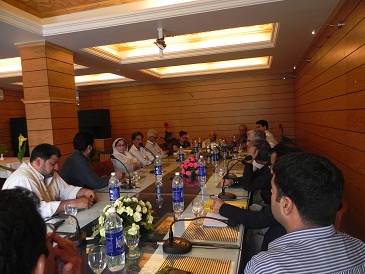 Engagement of Kashmir leadership with any leader from New Delhi has not raised dust for the first time. There are many such instances. In fact, the political history from 1947 is replete with such instances.
Question is why do such engagements raise dust or leave behind a trail of dust. Is it trust deficit between leadership and the people? Or these meeting take place without well defined rules of engagement. The element of trust deficit has a history- leaders on a few occasion have betrayed people’s trust and pushed them into morass of uncertainties. Nevertheless, more than anything else, it is for the lack of well-defined rules of engagement that has been casting doubts on these meetings and these end up leaving behind nothing but a trail of dust and controversies.
It is tell tale story. What happens during these engagements whether held at the individual level or at the level of the State. These meetings have a set pattern: Hurriyat or other leaders recounting agonized stories of human rights violations in the state. In response, the other side expressing a word or two of sympathy and a promise to get them looked into. There is uniformity in this pattern whether the visitors include the Chairman of Kashmir Committee, an interlocutor or man at top in the government.
Much before its fragmentation the Hurriyat Conference entered into an engagement with New Delhi through various government agencies, interlocutors and intermediaries. These engagements over a decade culminated in the Hurriyat (M) getting a photo-ops with N.D.A leaders including Lal Kishen Advani. It is not possible to recount in this column Advanis take on these talks as contained in chapter ‘Dealing with Kashmir’ in his autobiography My Country My Life but one thing become evident that it was human rights situation and prisoners that had topped the agenda. However, the NDA government succeeded in taking sting out of the Hurriyat (M), “brought a change in its political beliefs, thought and action. The change was evident on the ground in its not asking people to boycott 2002 election.
The highest engagement that a faction of Kashmir leadership in the recent history had with New Delhi was with Prime Minister, Manmohan Singh during 2005. It is case in point why Manmohan Singh did not Mirwaiz and his faction for another meeting. The 2005 meeting also ended at photo-op. The answer is simple that the Mirwaiz faction also did not follow any rules of engagement. Ironically Hurriyat (M) is chasing dust raise by the meeting to this day.
zahidgm@greaterkashmir.com


Filed under: Editor's Take · Tags: Civil Soceity Kashmir, Kashmir Dialogue, Peace Process Kashmir, Ram Jeth Malani